Field note
Founder-Led Content: A Practical Playbook for 2026
Unlock the power of founder-led content. Build trust, drive demand, and achieve faster sales with our practical playbook for 2026.
TL;DR:
- Founder-led content builds trust and demand by showcasing a founder's unique voice, proof, and consistent posting. Systematic workflows, focused platform choices, and efficient tools enable founders to produce impactful content with minimal time investment, driving long-term search and pipeline benefits. Planning, delegation, and asset automation turn founder content into a scalable, compounding commercial asset over 6 to 18 months.
Founder-led content is the practice of a company's founder publishing their own voice, perspective, and expertise to build trust, drive inbound demand, and create a compounding body of work the brand alone cannot replicate. The single most important first step: pick one platform, define three content pillars, and publish something this week. Everything else is refinement.
Three elements separate founder content that compounds from content that disappears:
- Voice: Your specific opinions, hard-won lessons, and operator-level insight. Not polished brand copy.
- Proof: Evidence that backs your claims. Customer outcomes, product decisions, numbers you can share.
- Cadence: Consistency over brilliance. A post every week beats a perfect post every quarter.
Get those three right and the outcomes follow: lower customer acquisition costs, faster sales cycles, better candidates in your hiring pipeline, and a credibility signal that works for you before every investor call.
Table of Contents
- Why founder-led content gives startups an unfair advantage
- How do you overcome the real objections founders have?
- How do you build a founder content strategy that actually runs?
- What tools and templates do founders actually need?
- Which metrics actually tell you if founder content is working?
- What post types and templates work best for founders?
- Your 30-day launch checklist
- Key Takeaways
- Why treating founder content as a system changes everything
- Scale your founder content with assets dev
- Useful sources
- FAQ
Why founder-led content gives startups an unfair advantage
The business case is concrete. Founders who own their content saw 11% higher win rates on deals and closed deals 120% larger in cases cited by the source. Thought leadership content produced 156% average ROI when measured correctly. Those numbers reflect something structural: a founder's post carries operator nuance that a brand account simply cannot reproduce. Agency-translated content pays a "translation tax" every time a real insight gets softened into a press release.
The trust effect runs deeper than sales. Personal branding for founders is now a commercial imperative, not a vanity project. Before every investor meeting, every senior hire, and every partnership conversation, someone is searching your name. What they find shapes the conversation before it starts.
There is also an algorithmic dimension most founders miss. AI search tools, including ChatGPT, Perplexity, and Google's AI Overviews, preferentially surface person-bylined content that carries clear authority signals: consistent topical expertise, professional credentials, and a searchable body of work. Anonymous brand content competes on domain authority alone. A founder's byline adds a second dimension that AI citation engines reward.
The compounding effect is what makes this worth the early investment. A post you publish today becomes a searchable asset that drives inbound six months from now. HubSpot's founder content playbook frames it directly: founder content reduces repeat explanation in sales calls, lowers CAC over time, and can be systematized into a repeatable framework. The early posts do the most work, because they establish the topical footprint everything else builds on.

How do you overcome the real objections founders have?
Every founder who has not started yet has a version of the same four objections. Here is what actually works for each.
"I don't have time." The fix is not finding more time. It is changing the capture method. A 90-second voice memo recorded right after a customer call contains more usable insight than an hour of staring at a blank document. Record the observation, send it to a transcription tool like Otter.ai or Rev, and hand the transcript to an editor or AI assistant to shape into a draft. Your job is the raw material, not the finished post.
"I'm not a writer." You do not need to be. The founder's role in this system is to supply the insight and approve the final voice. A part-time content editor, a fractional content strategist, or even a well-prompted AI assistant handles structure and polish. The one thing you cannot outsource is your opinion. Keep that, delegate the rest.
"I'm afraid of oversharing." This is the most legitimate concern, and the answer is a simple personal guardrail: share lessons and frameworks, not live financials, unreleased product details, or anything that could constitute a material disclosure if you are investor-backed. The most compelling founder content is about how you think, not what your cap table looks like.
Pro Tip: Before publishing anything that references customers, investors, or employees, run a quick mental check: would this person be comfortable seeing this? If the answer is uncertain, either get explicit permission or make the example anonymous. One sentence of caution here saves a significant conversation later.
Legal and compliance note. If your company is publicly traded, in a quiet period, or subject to an NDA, treat content as a potential disclosure event. When in doubt, have counsel review posts that touch on financials, M&A, or product roadmaps. For most early-stage founders, the practical rule is simpler: share the insight, protect the specifics.
On delegation: the founder must personally own the origin of every piece. The perspective, the story, the opinion. Everything downstream, including editing, formatting, scheduling, distribution, and measurement, can and should be handled by someone else once you have the budget. Building a searchable author footprint requires owned author pages and third-party proof (podcasts, press, speaking engagements) to prevent "trust leakage," where prospects find your posts but no corroborating evidence. That infrastructure is a team task.
How do you build a founder content strategy that actually runs?
The operational backbone here is the Capture→Refine→Generate workflow: capture raw ideas daily, refine them in a single weekly session, and use tools to produce platform-ready assets while preserving your voice.
Choose your primary platform first
LinkedIn is the default for B2B founders and the most forgiving for long-form text. It rewards consistent posting, surfaces content to second-degree connections, and has the strongest organic reach for professional audiences. If your product is visual or consumer-facing, Instagram or YouTube Shorts may be the better primary platform. Short-form video on TikTok or Reels works for founders who are comfortable on camera and targeting a younger buyer.
Pick one primary platform and one secondary. A common pairing: LinkedIn as primary, with a Substack newsletter as secondary for longer-form thinking that you own outright. Do not split attention across four platforms in month one.
Define your ICP and three to five content pillars
Your content pillars should map directly to the problems your ideal customer profile (ICP) is trying to solve, not to topics you find interesting. A founder selling B2B SaaS to operations teams might anchor on: operational efficiency lessons, product decision transparency, and hiring and culture. Every post fits one of those three buckets. That constraint is what makes the content feel coherent over time rather than random.
The Capture→Refine→Generate workflow in practice
Daily capture (5 minutes): After any customer call, sales conversation, or product decision, record a voice memo. One observation, one lesson, one question you keep getting asked. That is your raw material.
Weekly refinement (30 minutes): Review the week's captures. Pick two or three worth developing. Write a rough outline or bullet points for each. This is not drafting; it is sorting.
Batch production (1–2 hours, once a week or every two weeks): Turn the refined outlines into finished posts. Use an AI assistant to draft from your outlines, then edit for voice. Batch three to five posts at once so you are never writing under deadline pressure.
Cadence and time budget
Two to three posts per week on your primary platform is the sweet spot for most founders. One longer post (400–800 words on LinkedIn, or a 5-minute video) plus one or two shorter reactive posts. Realistic weekly time investment: 90 minutes to two hours when the system is running. More in the first month while you find your voice.

Repurposing: one idea, multiple outputs
One long-form LinkedIn post becomes: two short clips for Instagram Reels or YouTube Shorts, a paragraph in your next newsletter, and a follow-up talking point for your sales team. Route the best-performing posts to your PR contact as proof of expertise for media pitches. A post that generates strong comments is a signal that the topic resonates with buyers, which is useful data for your sales deck too.
Roles and workflow
The founder supplies the origin. The team handles polish, scheduling, distribution, and measurement. A simple editorial calendar in Notion or Airtable, with columns for status (captured / in draft / scheduled / published / repurposed), keeps the pipeline visible without requiring daily check-ins.
What tools and templates do founders actually need?
The toolkit is deliberately short. Adding tools before the habit is set is a common way to stall.
Capture and transcription
Start with your phone's native voice memo app. Once you are capturing consistently, add Otter.ai or a similar transcription service to convert recordings to searchable text automatically. Rev is the higher-accuracy option for important recordings. Neither requires a complex setup.
Editing and co-creation templates
Three templates cover most of what you need:
Content brief template: Topic, ICP problem it addresses, one key insight, one piece of proof (stat, story, or customer outcome), and a call to action. Fill this out in two minutes before drafting anything.
Capture call agenda: A standing 15-minute weekly call between the founder and a content editor. The founder talks through three to five raw ideas; the editor takes notes and assigns drafts. No prep required from the founder beyond showing up.
3-line post template (for LinkedIn): Line 1: a specific claim or counterintuitive observation. Line 2: the evidence or story that backs it. Line 3: the implication or question for the reader. This structure works for 80% of short-form posts.
Distribution and repurposing
A simple Zapier or Make workflow can push published posts to a Slack channel for the sales team, tag them in a CRM, and trigger a newsletter digest. AI video tools can turn a founder's recorded clip into a branded short-form video with captions and a CTA overlay in minutes, which is the fastest way to repurpose without a video editor on staff.
Automating branded asset production
This is where an assets platform earns its keep. When you are publishing consistently across LinkedIn, Instagram, and Substack, manually resizing and rebranding images for each platform is the first thing that slows the system down. AI design tools that learn your brand in seconds and generate platform-ready images, video clips, and PDF assets via API or CLI fit directly into the Capture→Refine→Generate workflow. The founder records; the system produces the branded output.
Realistic cost: The tools described here run from free (voice memos, basic Zapier) to $20–$50 per month for transcription and automation. A fractional content editor costs $500–$2,000 per month depending on scope. That is a fraction of a single paid acquisition campaign, and it builds a permanent asset.
When to hire
Bring in a content assistant when you are capturing consistently but the refinement and production steps are falling behind. Hire a fractional editor when the content is good but distribution and repurposing are not happening. Do not hire before the capture habit is established; you will be paying someone to wait for your input.
Which metrics actually tell you if founder content is working?
Vanity metrics (likes, impressions) are not useless, but they are not the signal. The metrics that map to demand are different.
Primary metrics
| Metric | What it tells you | How to track it |
|---|---|---|
| Inbound leads citing content | Direct demand attribution | Ask in intake form: "How did you hear about us?" |
| Demo requests after a post | Content-to-pipeline velocity | Note post date vs. demo spike in CRM |
| Conversion rate, content-influenced leads | Quality of content-sourced pipeline | Tag leads by source in CRM, compare close rates |
| AI citation / search lift | Authority signal building | Search your name + topic monthly; track AI mentions |
| Engagement velocity | Resonance with ICP | Comments from target buyers, not just peers |
Secondary metrics
Reach and follower growth matter as lagging indicators. More useful in the short term: time-to-first-touch after a post (how quickly does a post generate a DM or inquiry?), recruiting inquiries that mention your content, and speaking or podcast invitations. Those last two are the clearest signals that real-world authority is building.
Instrumentation
Add one field to your CRM: "Content influence: yes/no + which post." Train your sales team to ask, in the first call, whether the prospect has read or seen anything from you before. That single question, asked consistently, gives you a content-influenced pipeline number within 90 days.
Use UTM parameters on any link you share in posts. A simple naming convention (utm_source=linkedin, utm_campaign=founder-post, utm_content=post-title) lets you see in Google Analytics exactly which posts drove site visits and conversions.
Benchmarks to expect
Ecommerce founders publishing consistently report 2–4x higher engagement on founder content compared to brand-account content, and 20–40% improvements in paid acquisition efficiency over 12–18 months. Thought leadership content produced 156% average ROI when measured correctly. Meaningful search lift typically appears in 6–12 months. These are realistic ranges, not guarantees, and they assume consistent publishing, not occasional posting.
Weekly: Check engagement velocity on recent posts. Note any inbound leads or DMs. Monthly: Review content-influenced pipeline. Check AI citation and search visibility for your name and core topics. Quarterly: Assess CAC trend for content-influenced leads versus paid. Adjust pillars based on what is generating pipeline, not just engagement.
What post types and templates work best for founders?
Five formats consistently outperform everything else for founder content.
Origin story
Tell the specific moment you decided to build this. Not the polished version. The version with the problem that frustrated you, the thing you tried that did not work, and the decision point. Origin stories build emotional connection faster than any product feature.
Template: "I built [product] because [specific frustrating experience]. I tried [existing solution] and [what failed]. So I [what you did instead]. Here's what I learned."
Product teardown
Walk through a decision you made in the product and why. Founders underestimate how much buyers want to understand the thinking behind the product. A post explaining why you chose a specific pricing model, or why you killed a feature, signals confidence and transparency.
Customer-objection answer
Take the most common objection you hear in sales calls and answer it publicly. "The #1 reason people don't buy [product] is [objection]. Here's the honest answer." This post does double duty: it builds trust with prospects and gives your sales team a shareable asset.
Pricing trade-off
Explain what your pricing reflects and what it does not. Founders who are transparent about trade-offs attract better-fit customers and repel bad-fit ones. Both outcomes save time.
X-minute lesson
"In 3 minutes: what I learned about [topic] after [specific experience]." Time-bounded lessons perform well because they set a clear expectation and deliver on it. Keep it to one insight, not five.
LinkedIn short-form example
The mistake most founders make with content: They write for their peers, not their buyers. Your customers don't care about your funding round. They care whether you understand their problem. Write the post your best customer needs to read today.
Short-form video script structure
Hook (5 seconds): One counterintuitive claim. Context (20 seconds): Why this matters to your viewer. Proof (20 seconds): One specific example or data point. Close (5 seconds): One question or next step. No intro, no "hey guys," no preamble.
Pro Tip: For LinkedIn video best practices, always add captions. Most LinkedIn video is watched without sound, and captions lift completion rates significantly.
Your 30-day launch checklist
This is the minimum viable launch. Do not add to it in week one.
Week 1: Foundation
- Choose your primary platform (LinkedIn recommended for B2B) and one secondary
- Write down your three content pillars (ICP problem 1, ICP problem 2, founder perspective)
- Set up a simple content calendar (a Notion table or Google Sheet with columns: idea / status / publish date / platform)
- Record five voice memos this week: one per customer interaction or product decision
- Set up Otter.ai or a similar transcription tool
Week 2: First publish
- Refine two to three captures from week one into post outlines
- Publish one longer post (origin story or product teardown)
- Publish two shorter posts (one lesson, one objection answer)
- Add UTM parameters to any links in posts
- Add the "content influence" field to your CRM
Week 3: Iterate and route
- Review which post generated the most comments from target buyers (not just peers)
- Repurpose the top post into one short-form clip and one newsletter paragraph
- Start routing strong posts to your sales team as shareable assets
- Collect one piece of proof (a customer quote, a metric, an outcome) to use in next week's content
Week 4: Build the bank and measure
- Batch-produce five to seven posts for the next two weeks so you are never writing under pressure
- Pitch one podcast or guest article using your best-performing post as a proof of expertise
- Review your content-influenced pipeline: any inbound leads that mentioned a post?
- Adjust your cadence based on what is realistic, not what is ideal
The 90-day framework breaks this into three phases: voice and format (days 1–30), cadence and platform expansion (days 31–60), and compounding and measurement (days 61–90). Month one is entirely about establishing the habit and finding what resonates. Do not optimize prematurely.
Key Takeaways
Founder-led content compounds when it runs as a system: consistent voice capture, weekly refinement, and branded asset production that routes directly to sales and search.
| Point | Details |
|---|---|
| Start with one platform and three pillars | LinkedIn plus two to three ICP-focused pillars gives you a coherent, searchable body of work faster than spreading thin. |
| Use the Capture→Refine→Generate workflow | Daily voice memos, a 30-minute weekly refinement session, and batch production keep output consistent without burning out. |
| Track pipeline, not just engagement | Add a "content influence" field to your CRM and ask every new lead whether they saw your content before reaching out. |
| Expect compounding over 6–18 months | Ecommerce founders report 2–4x engagement lifts and 20–40% paid acquisition efficiency gains over 12–18 months of consistent publishing. Thought leadership content produced 156% average ROI when measured correctly. |
| assets dev for branded asset production | assets dev fits directly into the Generate step, producing platform-ready images, videos, and PDFs with your branding in seconds via web, API, or CLI. |
Why treating founder content as a system changes everything
The conventional wisdom says founder content is about authenticity. Post raw, be vulnerable, show the behind-the-scenes. That advice is not wrong, but it is incomplete, and it is why most founders burn out after six weeks.
The founders who build durable content engines treat it the way they treat product development: as a system with inputs, outputs, and feedback loops. The insight is the raw material. The workflow is the production line. The metrics are the QA check. Authenticity is not a posting style; it is what happens when a founder's genuine perspective runs through a repeatable process.
There is also a compounding dynamic that most people underestimate. The tenth post you publish does not just reach the people who see it that week. It adds to a searchable body of work that AI search tools, journalists, and investors will find months later. Personal branding in 2026 is a commercial asset that affects fundraising, hiring, and sales simultaneously. A founder who has published 50 posts on a topic owns that topic in their market's mind in a way that no ad spend can replicate.
The mistake is treating content as a marketing channel. It is closer to a product. It needs a roadmap, a production process, and a measurement system. Build those three things and the "authenticity" takes care of itself, because you are no longer improvising under pressure.
Scale your founder content with assets dev
The hardest part of the Generate step is not writing the post. It is producing the branded image, the short video clip, and the PDF one-pager that make the post worth clicking on every single platform, every single week.
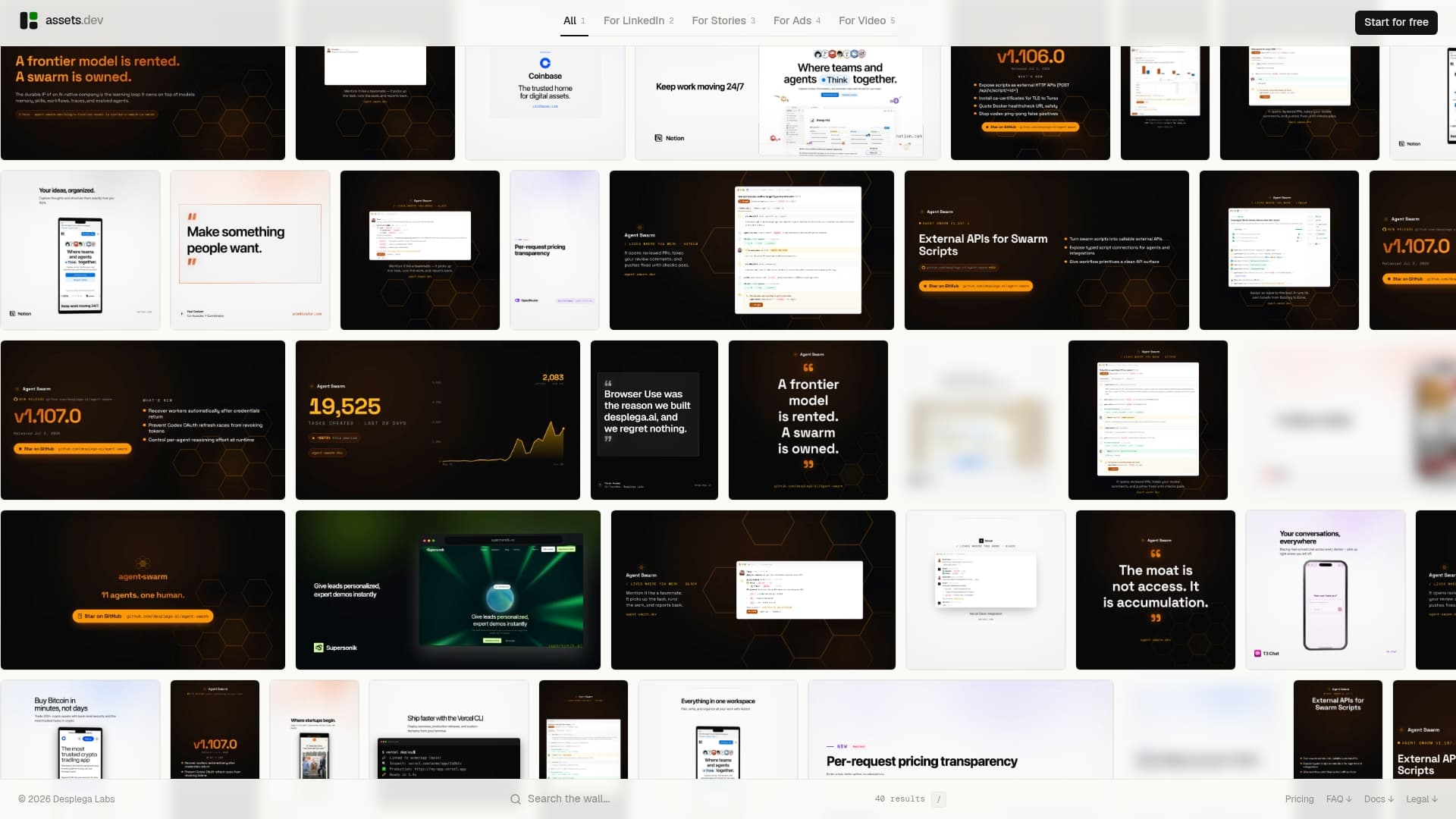
assets dev is built for exactly that moment. The platform learns your brand in seconds and generates platform-ready images, videos, and PDFs tailored to LinkedIn, Instagram, X, Substack, and more. You can run it from the web interface or plug it directly into your automated growth workflow via CLI, API, or MCP integration, so the branded asset is produced the moment the post is ready.
- Brand-consistent output at speed: Feed your brand once; every asset that follows matches it automatically.
- Automation-ready: The API and CLI integrations slot into the Capture→Refine→Generate workflow without manual steps.
- Curated templates for founders: Choose from high-quality templates built for growth marketing, or generate your own and customize per platform.
The free plan covers up to 100 image renderings or 10 videos with no credit card required. In July, new accounts get 1,000 credits instead of 100. The Pro plan is $9 per month. Start with the free plan at assets.dev and have your first branded founder post asset ready today.
Useful sources
The sources below back the claims in this article and are worth bookmarking for deeper reading.
- How to Build a Founder-Led Content Strategy — (HubSpot Startups) — HubSpot's operational playbook for systematizing founder content, including CAC reduction and the repeatable framework approach.
- Why Personal Branding Is No Longer Optional For Founders In 2026 — (Forbes) — Forbes' case for treating personal branding as a commercial asset affecting fundraising, hiring, and sales.
FAQ
What is founder-led content?
Founder-led content is content published under a founder's own name and voice, sharing their expertise, perspective, and operator insight to build trust, drive inbound demand, and create a compounding body of work. It differs from brand content because it carries a person's credibility, not just a company's.
What is an example of founder-led marketing?
A founder publishing a LinkedIn post explaining why they made a specific product pricing decision, then repurposing that post into a short video and a newsletter section, is a clear example. The content originates from the founder's direct experience and routes to sales, search, and recruiting simultaneously.
What is the founder-led approach?
The founder-led approach treats the founder's voice and expertise as a primary distribution channel. Rather than routing all communication through a brand account or PR team, the founder publishes directly, which preserves operator nuance and builds personal authority that compounds over time.
How much time does founder content actually take?
With the Capture→Refine→Generate workflow, the realistic weekly time investment is 90 minutes to two hours once the system is running. The founder's role is capturing raw ideas (voice memos after calls) and approving final drafts; editing, formatting, and distribution can be delegated.
Can assets dev help founders produce content faster?
Yes. assets dev fits into the Generate step of the workflow, producing brand-consistent images, short videos, and PDFs for LinkedIn, Instagram, X, and Substack from a single brand setup. The free plan (100 image renderings or 10 videos, no credit card required) is enough to test the workflow before committing to the $9/month Pro plan.