Field note
Marketing Analysts: Multi Channel Branding That Delivers 287% Lift
System centric multi channel branding for marketing analysts: checklist, seven step build, audit scorecard, and the 287% lift evidence.
Multi-channel branding is a system-centric identity, built on rules rather than fixed files, that adapts to each platform's grammar while staying recognizable everywhere it appears. Done right, it does not mean pasting the same square logo on every channel; it means locking your brand's core elements and letting trained templates or automation handle the resizing, retiming, and reformatting. The payoff shows up in the numbers below, and the checklist that follows shows exactly how to build it with expert content strategy services for SEO, AEO & GEO.
TL;DR:
- Engaging across three or more channels can lead to a 287% increase in purchase rate, provided brand assets are consistently and cohesively presented.
- Building a multichannel system involves defining core brand rules first, then designing adaptable templates to prevent visual or tone fragmentation.
- Regular measurement of KPIs such as cross-channel conversion lift and brand-alignment scores ensures ongoing consistency and effective scaling.
- Automating asset deployment highlights where brand rules are vague and speeds up production without sacrificing recognition or quality.
- Adapting assets to platform-specific formats, ratios, and copy styles is essential for recognition, not simply copying the same content everywhere.
Table of Contents
- What Is Multi-Channel Branding, and How Does It Differ From Omnichannel?
- Why Multi-Channel Branding Moves the Numbers
- Where Multi-Channel Branding Usually Breaks Down
- How Do You Build a Multichannel Brand System Step by Step?
- How Do You Adapt Brand Assets Without Losing Recognition?
- How Do You Measure and Audit Brand Consistency?
- What Automating Brand Assets Actually Teaches You
- Scaling Brand-Consistent Assets Without Adding Headcount
- Sources
- FAQ
What Is Multi-Channel Branding, and How Does It Differ From Omnichannel?
Multichannel branding means showing up on several platforms, LinkedIn, Instagram, email, paid search, with a brand identity strong enough to survive the trip. Each channel runs its own campaign, its own creative, sometimes its own calendar. The connective tissue is the identity system: a locked palette, typography, logo lockups, and a voice guide that every asset draws from, regardless of where it lands.
Omnichannel marketing is a different ambition. It's customer-centric rather than channel-centric, meaning the goal is a single, continuous experience as a person moves from Instagram ad to email to in-store visit, often within the same purchase journey. McKinsey's research on omnichannel strategy notes that many customers now touch three to five channels before buying, and the integration between those touchpoints, not just their consistency, is what drives engagement.
Cross-channel advertising sits somewhere in between: it's about coordinating paid media timing and targeting across platforms without necessarily unifying the full customer data layer that omnichannel requires.
For most marketing teams, especially lean ones, multichannel branding is the right starting point. It demands less infrastructure than a true omnichannel build, lets you specialize creative by channel strength, and scales with the resources you actually have. You can layer omnichannel-style journey mapping on top later, once the foundational brand system and governance are solid.
Why Multi-Channel Branding Moves the Numbers
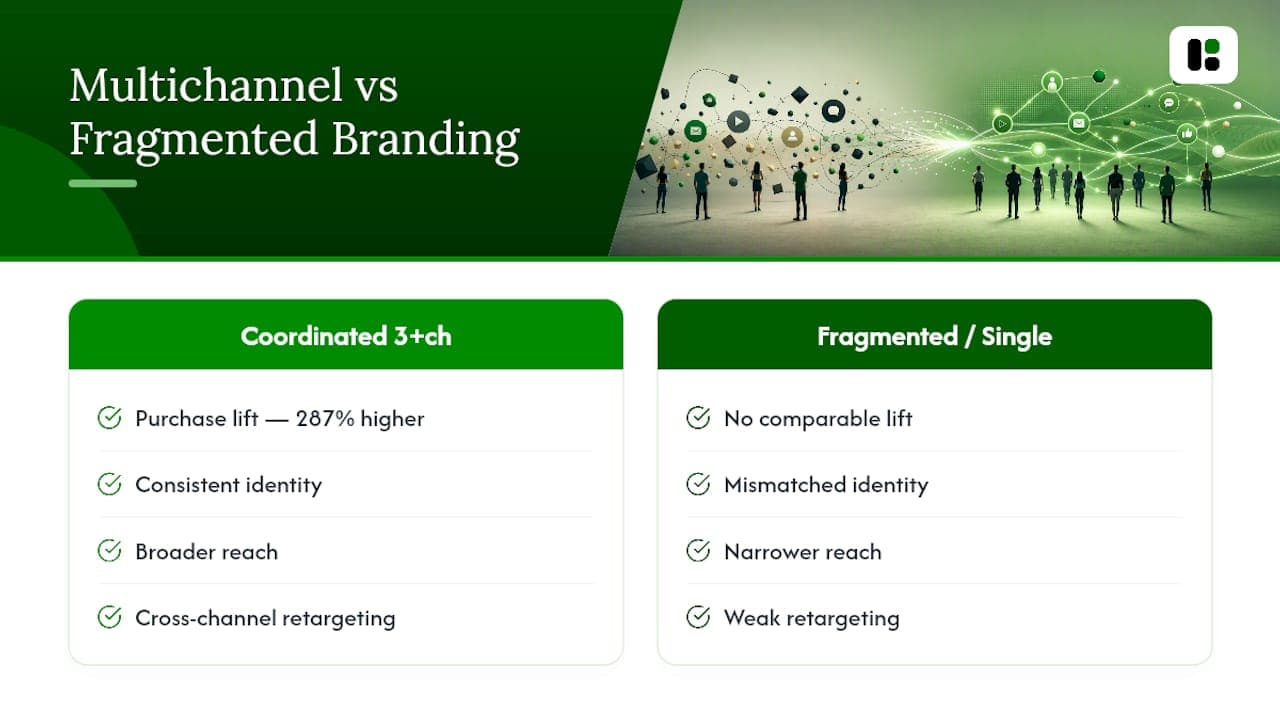
The clearest evidence comes from Wharton: brands that actively engage audiences across three or more channels report a 287% higher purchase rate compared to single-channel approaches.
The number that should reset your budget conversation: a 287% lift isn't a rounding error you get from "being on more platforms." It's what happens when the same recognizable brand shows up consistently enough, on enough channels, that repeated exposure compounds into purchase intent.
That statistic carries a caveat worth stating plainly: it measures brands that engage across channels, not brands that merely exist on them with mismatched fonts and off-brand colors. Fragmented execution erodes the lift before it happens.
Beyond purchase rate, teams running coordinated multichannel programs typically see broader reach (each platform pulls in audience segments the others miss), better campaign performance from cross-channel retargeting, and higher customer lifetime value when assets are adapted rather than copy-pasted. McKinsey's work on adaptive identity systems links that adaptability directly to CLV gains, since customers experience less friction moving between touchpoints.
B2B and B2C context matters here. B2B buying cycles are longer and more research-heavy, so multichannel branding often pays off through trust-building repetition across LinkedIn, email, and events. B2C tends to reward speed and volume, more channels, faster asset turnover, tighter feedback loops.
Where Multi-Channel Branding Usually Breaks Down
Most brand inconsistency isn't a design failure. It's a process failure that shows up as design failure.
- Visual and tone fragmentation. Different teams, or different freelancers, produce assets for each channel without a shared source file, so colors drift and voice shifts from professional on LinkedIn to overly casual on Instagram.
- The "1:1 uniformity" trap. Some teams overcorrect by forcing identical creative across every platform, ignoring that a square Instagram carousel and a horizontal LinkedIn banner have completely different native grammar. This kills engagement even when it "protects" the logo.
- Data silos. Analytics live in separate dashboards per channel, so nobody can see whether the LinkedIn campaign is actually lifting email conversion, which hides the real measurement gap.
- No governance loop. Without a review cadence, small deviations, a slightly off shade of blue, an unapproved font substitution, accumulate until the brand looks inconsistent across its own campaigns.
Each of these is fixable with structure, not more creative talent. That's the encouraging part.
How Do You Build a Multichannel Brand System Step by Step?
Building the system beats reacting channel by channel. Here's the sequence that holds up across teams of different sizes.
- Lock the brand core first. Define your palette, typography, logo lockups, and voice as rules, not files. Think of it as a rulebook a designer or an AI tool can apply consistently, rather than a static asset folder.
- Design the modular layer. Build adaptive components (icon sets, background treatments, headline styles) that flex around the fixed core, so a LinkedIn carousel and an Instagram Reel both read as unmistakably your brand without looking identical.
- Map the customer journey and pick 3–5 channels. Prioritize based on where your actual buyers spend attention, not where competitors post. McKinsey's guidance to start with strategic ambition and value drivers before choosing tools applies directly here.
- Build locked templates and a central DAM. A digital asset management system with locked templates makes the on-brand choice the easy choice, which cuts drift dramatically compared to relying on manual review.
- Instrument measurement before you scale. Define your KPIs, pick an attribution model, and set an audit cadence (quarterly is common) before you add more channels or automation.
- Pilot automation, then scale. Start with one repetitive asset type, say, resizing a campaign visual for five platforms, run it through a template or automation tool, and validate quality before expanding. SAS recommends building toward a single customer view, a real multichannel platform, and consistent experiences as the three practical milestones.
- Scale with brand-kit automation and CI on outputs. Once templates are locked, apply continuous quality checks the same way engineering teams apply continuous integration to code, catching drift before it ships.
Pro Tip: Run your first automation pilot on your lowest-risk channel, not your flagship one. If something breaks, you want it to be the newsletter footer, not the LinkedIn campaign your CMO is watching.
How Do You Adapt Brand Assets Without Losing Recognition?
Platform appropriateness beats identical visual mirroring, full stop. A brand that looks native on Instagram and stiff on LinkedIn has actually failed at consistency, even though every pixel matches. Recognition comes from repeated brand cues (color, type, voice), not from a single fixed layout forced onto every canvas.
The technical constraints differ enough to demand real variants:
- Aspect ratios and safe zones vary by platform (Instagram Stories run vertical, LinkedIn feed images run closer to square or landscape), and your template system needs a variant for each, not a crop-on-export afterthought.
- Text density limits matter more on X and Instagram, where overlay text competes with captions, than on a PDF one-pager built for slower reading.
- Logo minimum sizes and animation length need explicit rules; a logo that reads fine on a full-bleed LinkedIn banner can disappear on a thumbnail-sized X post.
- Native copy cadence differs too: Substack rewards longer, narrative voice, while X rewards a single sharp line. The brand voice guide should specify tone anchors that flex by channel length, not a single fixed script.
Templates that encode these rules once, rather than relying on a designer to remember them per project, are what let a small team stay consistent at volume. Programmatic and AI-assisted adaptation is becoming the practical way to generate that volume without adding headcount, applying the locked rules automatically rather than leaving them to memory. For creative direction specific to feed formats, Instagram content design resources are worth studying alongside your own template library.
How Do You Measure and Audit Brand Consistency?
Governance without measurement is just opinion. The KPIs that actually tell you whether the system is working:
| Metric | What it reveals | Typical cadence |
|---|---|---|
| Cross-channel conversion lift | Whether integrated campaigns outperform single-channel runs | Monthly |
| Customer lifetime value by channel mix | Whether adapted, consistent assets improve retention | Quarterly |
| Brand-alignment score | How closely live assets match the locked brand rules | Quarterly |
| % of assets from locked templates | How much of output is governed vs. ad hoc | Monthly |
Attribution is the trickiest piece. Multi-touch attribution models help you see which channels contribute to a conversion, but they can overweight last-click channels if you're not careful. The pragmatic fix most teams land on: track directional lift by channel combination rather than chasing perfect attribution precision, and revisit the model quarterly as channel mix shifts.
For the brand-alignment score itself, a five-dimension audit works well in practice: color accuracy, typography compliance, logo usage, imagery alignment, and voice or tone. Score each touchpoint on all five, and you'll usually find the same one or two dimensions, often typography compliance or tone, driving most of the drift. That's where remediation effort should go first, not spread evenly across all five.
What Automating Brand Assets Actually Teaches You
Automating template deployment across channels exposes where brand rules were vague, not just where execution was slow. Teams that lock their core identity into rules first, then automate distribution through CLI or API integrations, tend to cut inconsistent assets faster than teams that automate before defining the rules. Automation speeds up production; it doesn't replace the strategic decisions about voice, audience, and positioning that a system has to encode in the first place.
— Desplega Labs
Scaling Brand-Consistent Assets Without Adding Headcount
Most of the friction in multi-channel branding isn't creative, it's operational: someone has to resize, retone, and reformat the same campaign for five platforms, every single week. assets dev learns your brand core in seconds, then generates images, videos, and PDFs that already match your palette, typography, and voice across LinkedIn, Instagram, Google, X, and Substack.
You start from a curated template library or generate your own, and the platform's CLI, API, and MCP integrations mean the same brand-locked output can plug straight into your existing automation flows rather than sitting in a separate design queue. The free plan covers up to 10 videos or 100 image renderings with no credit card required, and through July, new accounts get 1,000 credits instead of the usual 100, enough to pilot a full multi-channel campaign before deciding whether to upgrade. The paid plan runs $9 a month if you outgrow the free tier. If your current bottleneck is turning one campaign into five platform-native versions without breaking brand rules, start a free account on the assets dev platform and run your next campaign through it.
Sources
- What is omnichannel marketing? — Wharton Executive Education
- What is omnichannel marketing — McKinsey
- Multichannel Marketing — SAS Insights
FAQ
What Is an Example of Multichannel Marketing?
A retail brand running a product launch through Instagram ads, an email sequence, a LinkedIn announcement, and Google search ads, each tailored to its channel's format but sharing the same locked colors, typography, and voice, is a textbook multichannel campaign.
What Is the 3-3-3 Rule in Marketing?
Definitions of the 3-3-3 rule vary by source and context, so treat any specific version cautiously; the consistent thread across usages is prioritizing a small, focused set of channels or messages rather than spreading effort too thin.
What Are the Three Types of Branding?
Branding is commonly grouped into corporate branding (the overarching company identity), product branding (identity built around a specific product line), and personal branding (identity built around an individual). Multi-channel branding applies the same core identity across all three when a company operates at that scale.
What Is Multi-Channel Marketing?
Multichannel marketing is the practice of promoting a brand or product across several platforms, such as email, social media, and paid search, using channel-specific campaigns that still share one consistent underlying identity. It differs from omnichannel marketing, which prioritizes a single integrated customer journey across those same channels.
How Do You Know If Your Multichannel Branding Is Working?
Track cross-channel conversion lift, the percentage of assets pulled from locked templates, and a quarterly brand-alignment audit score. If the audit consistently flags the same one or two dimensions, like typography or tone, that's your actual bottleneck, not the number of channels you're on.