Field note
Prompt Engineering Branding: A Marketer's Playbook
Unlock the power of prompt engineering branding to ensure every AI-generated output reflects your unique voice and brand identity.
Prompt engineering branding is the practice of encoding your brand's identity, voice, and guardrails directly into the prompts you write, so every AI output (an ad, an email, a landing page) sounds like you wrote it, not a generic model. The single first action: build a compact Brand DNA text block, a short document covering your audience, tone, key phrases, and hard constraints, and paste it into every prompt as context or a system instruction.
Skip this step and you get what most marketing teams get: technically fine copy that reads like it came from nowhere in particular.
Your Brand DNA block should include:
- Persona: who you're writing as (a specific voice, not "professional and friendly")
- Tone anchors: 3 to 5 adjectives with an example sentence for each
- Dos and don'ts: phrases you always use, phrases you ban
- Key phrases: taglines, product names, category language you own
- One or two examples: real copy that already sounds like you
Pro Tip: Keep your Brand DNA block under 200 words. A bloated brand document gets ignored by the model the same way a 40-page style guide gets ignored by a new hire.
Here's what injecting it looks like in practice:
System instruction: "You are writing as [Brand]. Voice: direct, a little irreverent, zero corporate jargon. Never use the words 'seamless' or 'revolutionary.' Always end with a specific next step." Then: "Write three headline options for a LinkedIn ad promoting our new integration."
Key Takeaways
Prompt engineering branding works because a persistent Brand DNA block, structured prompt components, and disciplined testing consistently outproduce ad-hoc, one-off instructions.
| Point | Details |
|---|---|
| Build a Brand DNA block first | Assemble persona, tone, key phrases, and constraints into one compact text document before writing any marketing prompt. |
| Follow the standard prompt anatomy | Include objective, system instruction, context, constraints, few-shot examples, and format in every prompt. |
| Test prompts like code | Run A/B experiments between prompt versions and track brand fidelity, conversion lift, and output variance. |
| Know when to scale beyond manual prompting | Move to orchestration tools or integrated workflows once requests exceed a few manual prompts per week. |
| Use a platform built for brand persistence | assets.dev keeps your Brand DNA saved across sessions and generates on-brand images, videos, and PDFs through its web app, CLI, or API. |
Table of Contents
- What Is Prompt Engineering Branding and Why Marketers Need It
- Anatomy of a Brand Prompt: The Components You Must Include
- Ready-to-Use Prompt Templates for Ads, Emails, and Social
- Higher-Payoff Techniques for Better Prompt Reliability
- How to Measure and Iterate on Prompt Performance
- Tools and Workflows to Scale Prompt-Driven Branding
- Keeping AI Outputs on Brand: Guardrails That Actually Work
- Quick Checklist: How to Write a Brand-Consistent Prompt
- Prompting as Design, Not a One-Time Trick
- What We've Learned Building Brand-Aware Prompt Tools
- How assets.dev Turns Brand DNA Into Ready-to-Ship Assets
- Sources
- FAQ
What Is Prompt Engineering Branding and Why Marketers Need It
Prompt engineering branding changes how fast a marketing team can move, and it changes what breaks when nobody's watching the details. Once a prompt carries your brand's identity baked in, generating twenty ad variants takes the same effort as generating two. The bottleneck shifts from "can we produce this" to "can we produce this correctly," and that shift is where most teams get caught flat.
Ad-hoc prompting, the kind where every team member writes their own instructions from scratch, produces brand drift fast. One copywriter's "friendly and casual" becomes another's "playful," and by the third campaign your brand voice has quietly mutated into something nobody signed off on. Worse, prompts without constraints tend to invent claims, mishandle regulated language, or slip into a competitor's tone because the model has no anchor telling it otherwise.
The upside, when it's done right, is concrete. Teams that standardize their prompts report faster creative testing cycles because they can spin up dozens of on-brand variants without a full creative review each time. Tone stays consistent across a LinkedIn post, a Google ad, and an email subject line, even when three different people or three different tools generated them. That consistency compounds: a reader who sees the same voice across five touchpoints trusts the brand more than one who sees five slightly different personalities.

Pro Tip: Don't try to standardize every channel at once. Start with paid creative and landing pages, since they carry the most direct revenue impact and the clearest, most measurable output (click-through rate, conversion rate) to judge whether your prompt structure is actually working.
Anatomy of a Brand Prompt: The Components You Must Include
A brand prompt isn't a single sentence. It's a structured set of components, and skipping one is usually where things go wrong. Google Cloud's prompt engineering guide identifies the core building blocks that affect output quality: objective, system instructions, context, constraints, tone, few-shot examples, and response format. Ordering and structure matter as much as the content itself.
Here's what each component looks like in a real marketing prompt:
- Objective: "Write a 3-email nurture sequence for trial users who haven't activated yet."
- Persona/system instruction: "You are [Brand]'s email copywriter. Voice: warm but direct, never salesy."
- Context/Brand DNA: your compact brand block, pasted in full or referenced as an attached document.
- Constraints/guardrails: "Each email under 150 words. No exclamation points. Never mention pricing in email one."
- Few-shot examples: one or two real emails that already hit the mark, pasted as reference.
- Response format: "Return as three sections labeled Email 1, Email 2, Email 3, each with subject line and body."
- Recap: a closing line restating the non-negotiable constraints.
On ordering: Gemini's prompting documentation recommends anchoring long context first, before the specific instruction, and using consistent delimiters (triple quotes, XML-style tags, or clear headers) to separate Brand DNA from the task itself. A prompt that mixes brand rules and task instructions in one run-on paragraph gives the model less to grab onto than one with clean sections.
Whether to package brand rules as a single-line instruction or a structured block depends on complexity. A simple tone constraint fits in one sentence. A full Brand DNA with personas, banned phrases, and multiple examples works better as a labeled text block you paste in wholesale.
Pro Tip: End every prompt with a one-line recap of your hardest constraints. Models tend to weight instructions near the end of a prompt more heavily, so a closing line like "Recap: no jargon, always include a CTA, tone stays conversational" acts as a final lock before generation.
Ready-to-Use Prompt Templates for Ads, Emails, and Social
These templates assume you've already got a Brand DNA block ready to paste in. Attach it as context at the top of each prompt, then layer the task-specific instruction underneath.
1. Paid ad headlines and descriptions
"[Brand DNA]. Write 5 headline options (max 30 characters for Google, max 40 for Meta) and 3 description lines (max 90 characters) for [product/offer]. Each headline should lead with a benefit, not a feature. Avoid superlatives like 'best' or 'ultimate.'"
Example output pair: Input asks for a project management tool's Google ad. Output: "Stop Missing Deadlines" / "Track every task in one place. Free 14-day trial." That's benefit-first, character-compliant, no superlatives.
2. Multi-step email sequences
"[Brand DNA]. Write a 4-email onboarding sequence for new signups. Email 1: welcome, set expectations. Email 2: highlight one core feature with a use case. Email 3: address a common objection. Email 4: soft upsell to paid plan. Each email under 175 words, one CTA per email."
3. Landing page hero copy
"[Brand DNA]. Write hero section copy for a landing page targeting [audience]. Include: headline (under 10 words), subheadline (under 20 words), and CTA button text (2-3 words). The headline should name the outcome, not the product category."
4. Organic social posts
"[Brand DNA]. Write 3 LinkedIn posts (150-200 words each) about [topic]. Each should open with a hook that doesn't sound like a headline, include one concrete example or number, and end with a question that invites comment, not a hard sell."
5. Brand-voice calibration
"[Brand DNA]. Here are two examples of our actual published copy: [Example 1] [Example 2]. Rewrite the following draft to match this voice exactly, keeping the same information: [draft copy]."
Platform constraints matter more than most marketers account for. Google ad headlines cap at 30 characters, Meta gives you more room but rewards a punchier first line, LinkedIn tolerates longer-form thinking, and X compresses everything into a fast scroll. A curated collection of branding prompts built for small business use shows how far you can push tone and palette prompts before they need platform-specific tuning, and the same logic applies to headline length and CTA phrasing across channels.
Few-shot examples matter more here than almost anywhere else in your prompt stack. A single exemplar input-output pair, one ad you already ran that performed well paired with the prompt that generated it, teaches the model your standard faster than three paragraphs of tone description. Two examples usually beats one; beyond that, returns diminish and your prompt gets bloated.
For video and social content specifically, keeping brand voice consistent gets harder because tone shows up in pacing and visual style, not just words. Review templates built for Instagram marketing and video generator workflows if your team is producing across both static and motion assets.
Short prompts work fine for single-asset requests, a headline, a subject line. Long-context prompts, where you attach a full Brand DNA plus multiple examples plus platform constraints, make more sense for batch generation, when you're producing a week's worth of social posts or a full email sequence in one pass. Attach Brand DNA as a persistent system instruction where your tool supports it, so you're not re-pasting it into every single request.
Higher-Payoff Techniques for Better Prompt Reliability
Once your basic prompt structure is solid, a handful of advanced techniques cut manual rework further. A survey of prompt engineering methods catalogs the ones marketing teams are actually adopting:
- Few-shot prompting: showing the model 2 to 3 examples of desired output rather than describing it abstractly. Best for tone matching and format consistency.
- Chain-of-Thought: asking the model to reason step by step before producing final copy. Useful for content planning ("first list the three audience pain points, then write copy addressing each") but usually stripped from the final output.
- Reflection: having the model critique its own draft against your constraints before finalizing. "Review your draft above. Does it violate any of the constraints in the recap? Revise if so."
- Rails: hard-coded canonical forms and constraints the model can't deviate from, like a fixed CTA phrase or a required disclaimer line.
- Agent patterns: chaining multiple prompts together, one to research, one to draft, one to review, for complex, multi-step content production.
Use few-shot and Chain-of-Thought during ideation, when you want range and are still exploring angles. Save Reflection and Rails for final copy generation, when the priority shifts from creativity to compliance.
A mini example of Reflection in action: ask the model to draft a product announcement, then follow with "Check your draft against these rules: no unverified claims, tone stays under 200 words, includes one customer-facing benefit. List any violations, then rewrite." That second pass catches drift a single-shot prompt usually misses.
How to Measure and Iterate on Prompt Performance
Treat your prompts like code: version them, test them, measure the output, and refine. A workflow described in research on prompt engineering methodology frames this as an iterative loop, define objectives, build the prompt, run it, evaluate, refine, rather than a one-shot exercise.
Track these metrics:
- Brand voice fidelity: does a human reviewer, blind to which version is which, correctly identify the on-brand output?
- Conversion lift: CTR and CVR for ad and landing page variants generated by different prompt versions.
- Readability and read time: flag copy that's technically correct but slower to parse than your baseline.
- Hallucination rate: how often does the output invent a feature, statistic, or claim you didn't provide?
- Repeatability: run the same prompt five times. How much does output vary? High variance means your constraints aren't tight enough.
Run experiments the way you'd run any A/B test: baseline prompt against one variant at a time, not five changes at once. Give each test enough volume to reach statistical relevance before calling a winner, and keep the measurement window consistent (don't compare a one-week test against a three-week one).
Pair quantitative signals with a short qualitative review, a checklist a human runs through: does this sound like us, does it violate any banned phrases, would our brand lead sign off on this without edits.
Pro Tip: Log every prompt version alongside the model, temperature setting, and any seed value used to generate it. Six weeks from now, when a variant outperforms and you want to know why, "we changed something" isn't an answer you can act on.
Tools and Workflows to Scale Prompt-Driven Branding
Manual copy-paste prompting works fine until you're producing more than a handful of assets a week. Past that, the tooling category you need depends on your team's shape.
Prompt libraries are just organized collections of your best-performing prompts, often good enough for a small team. Prompt managers add versioning and testing on top. Orchestration frameworks like LangChain chain multiple prompts into pipelines, drafting, reviewing, formatting, and are worth adopting once your workflow involves more than one model call per asset. Full-stack platforms combine templates, brand persistence, and automation in one place.
Integration patterns worth knowing: API-first automation lets you trigger generation from your existing MarTech stack rather than a chat window. Embedding Brand DNA directly into system instructions, rather than re-pasting it per request, is the single biggest time-saver once volume climbs. Some teams even run prompt versions through CI-style testing before pushing them into production content calendars.

The scale signal to watch for: once your team is manually pasting the same Brand DNA block into more than a few requests a week, or someone asks "can we automate this," you've outgrown pure manual prompting. Review tooling comparisons or budget-conscious options before committing to a stack. For teams that need hands-on implementation support standing up these workflows, Sonance AI Solutions offers managed integration services worth a look.
Keeping AI Outputs on Brand: Guardrails That Actually Work
Guardrails are the constraints that stop a technically good prompt from producing an off-brand output anyway. Build a short, reusable list and paste it into every prompt, not just the ones you remember to double-check.
Your guardrail checklist should cover:
- Banned phrases: words or clichés your brand never uses (list them explicitly, don't assume the model will guess).
- Mandatory phrases: legal disclaimers, trademark symbols, required CTAs.
- Tone anchors: 2 to 3 words with an example sentence for each.
- Persona line: one sentence describing who's "speaking."
- Legal/claims constraints: no unverified statistics, no comparative claims without substantiation, no medical or financial guarantees.
A pasteable example: "Constraints: never claim 'guaranteed results.' Always include the phrase 'individual results may vary' in testimonials. Tone stays conversational, never corporate. Recap these before finalizing your response."
Build a compliance checkpoint into your workflow, one named reviewer who checks generated copy against this list before it publishes, especially for regulated claims or paid media. It takes minutes and catches the errors an unattended prompt misses.
Pro Tip: Your Brand DNA isn't a document you write once. Update it every few weeks with phrases and examples pulled from your actual best-performing production copy, so it keeps reflecting what's working, not just what you assumed would work at launch.
Quick Checklist: How to Write a Brand-Consistent Prompt
Copy this into your prompt editor or template library:
- Paste your Brand DNA block (persona, tone, key phrases, constraints).
- State the objective in one clear sentence.
- Add the persona/system instruction line.
- List hard constraints (length, banned words, required phrases).
- Attach 1 to 2 few-shot examples of your best existing copy.
- Specify the output format (labeled sections, character limits, structure).
- Close with a recap line restating your top 2 to 3 constraints.
- Adjust for platform limits (character counts, CTA conventions) before sending.
Ready-to-use snippet: "[Brand DNA block]. Objective: write 3 Instagram caption options for [product launch]. Constraints: under 125 characters, one emoji max, no exclamation points, end with a question. Format: numbered list. Recap: casual tone, no hard sell."
For platform-specific edits, swap only the character limit and CTA convention line, everything else in your Brand DNA block stays fixed.
Prompting as Design, Not a One-Time Trick
Marketers who get the best long-term results treat prompts less like search queries and more like creative briefs. The WIRE+FRAME framing from Smashing Magazine makes this explicit: a prompt is a conversation design artifact, something you draft, test, and revise the same way you'd revise a creative brief before handing it to a design team.
That mindset shift matters because it sets expectations correctly. A brief doesn't produce perfect output on the first try, and neither does a prompt. Build in a revision loop from the start instead of treating the first output as final.
There's a caveat worth taking seriously, though. Guidance on on-brand AI customization points out that manual prompting is genuinely useful for exploration, testing angles, drafting variants, finding your voice, but it's rarely the right long-term scale strategy on its own. Teams that need brand-accurate output at high volume eventually need custom models or integrated workflows layered on top of good prompting, not a single mega-prompt trying to do everything.
Pro Tip: Document your brand rules as a machine-readable text file, not a slide deck. A plain text or JSON Brand DNA block is something you can version, diff, and plug into automated pipelines later, a slide deck isn't.
What We've Learned Building Brand-Aware Prompt Tools
We built our own workflow around the same principle this article argues for: a Brand DNA that persists across every generation session, rather than getting rebuilt from scratch each time someone opens a chat window. In practice, that means the first few minutes with a new brand go into calibration, tone, key phrases, constraints, and every asset after that inherits those rules automatically rather than needing them re-explained.
The clearest signal that a team has outgrown manual prompting is when they start asking for API or CLI access instead of a chat interface. That request usually means the workflow has moved from experimentation to production, and production workflows need automation, not another copy-paste step.
How assets.dev Turns Brand DNA Into Ready-to-Ship Assets
Everything covered here, the Brand DNA block, the constraint recap, the few-shot examples, works, but rebuilding it by hand for every ad, email, and social post gets old fast. Assets is built around exactly that gap: a platform that learns your brand once and applies it automatically across every image, video, and PDF you generate afterward.
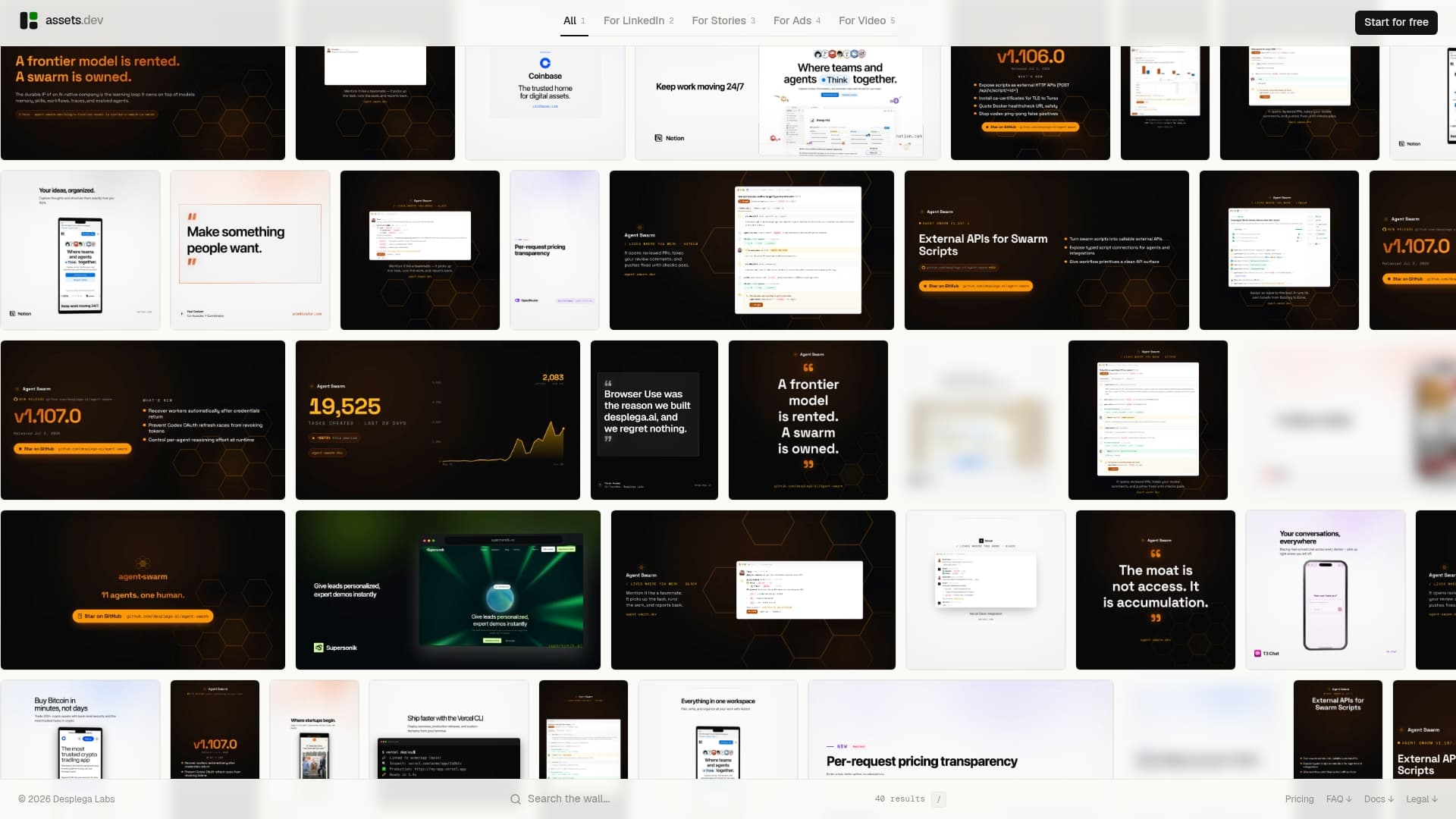
Three things make it worth trying if you've read this far. First, curated templates built specifically for growth marketing, not generic design templates repurposed for ads. Second, Brand DNA that persists: teach it your tone and constraints once, and it carries through every future asset without re-pasting a brief. Third, CLI, API, and MCP integrations, so once your team is ready to move past manual prompting, the automation is already there waiting.
The free plan needs no credit card and covers up to 10 videos or 100 image renderings, and through July, new users get 1,000 credits instead of the usual 100. If you outgrow that, the only paid tier runs $9 a month. Start by Assets and generate your first batch of on-brand assets today.
Sources
For readers who want to go past the practical playbook, these sources cover the engineering and design foundations behind everything above.
- Prompt Engineering for AI Guide | Google Cloud
- Survey of Prompt Engineering techniques and tools (arXiv)
FAQ
What Is Prompt Engineering Branding?
It's the practice of embedding your brand's voice, tone, and constraints directly into AI prompts, usually through a reusable Brand DNA block, so outputs stay consistent across every asset and channel.
What Should a Brand DNA Block Include?
At minimum: your brand persona, 3 to 5 tone anchors, banned and mandatory phrases, and one or two examples of copy that already sounds like you.
How Do I Keep AI Outputs From Sounding Generic?
Attach few-shot examples of your best existing copy to every prompt, and close with a recap line restating your top constraints, since models weight instructions near the end of a prompt more heavily.
When Should a Team Move Past Manual Prompting?
Once requests for the same Brand DNA exceed a handful per week, or teams start asking for API or CLI access, that's the signal to adopt orchestration tools or a platform like assets.dev that persists brand rules automatically.
What Metrics Matter Most for Prompt Performance?
Brand voice fidelity, conversion lift (CTR and CVR), hallucination rate, and repeatability across identical prompt runs are the core signals worth tracking in any testing framework.