Field note
Brand Voice AI: Build a System That Actually Works
Elevate your messaging with brand voice AI. Learn to create a consistent voice profile that sets your brand apart from the competition.
Create a machine-readable Voice Profile and feed it as system context before you generate a single word with AI. That one step separates brands that sound consistent from brands that sound like everyone else's ChatGPT output.
Before your first AI-generated asset, collect these:
- Your 5–10 best-performing, on-brand content pieces (annotated with why they work)
- A vocabulary list: preferred terms, banned phrases, and "use sparingly" words
- Your brand's mission statement and 3–5 behavioral voice pillars (not adjectives)
- Any existing style guide fragments, legal disclaimers, or compliance constraints
- Access to your AI tool's system prompt or context block
Pro Tip: Run one blind test immediately: generate a paragraph with no voice context, then generate the same paragraph with your Voice Profile loaded. The gap you see is the problem you are solving.
For teams that want a fast operational path, assets dev encodes your brand into templates and delivers them via API, CLI, or MCP integration so your automated workflows stay on-brand from day one.
Key Takeaways
A brand voice AI system works only when voice is defined as behavioral rules, encoded in persistent files, governed by a clear owner, and measured against a baseline.
| Point | Details |
|---|---|
| Build three persistent files | Voice Profile, Body of Work, and Design Tokens form the master context block every AI workflow needs. |
| Write behavioral rules, not adjectives | "Start with the claim" is executable; "be confident" is not — AI needs rules it can follow. |
| Separate voice from tone | Voice stays constant across channels; tone dials up or down by scenario (support, social, email). |
| Govern with a named owner | Without a Voice Owner and a versioned prompt store, drift is inevitable at scale. |
| assets dev for fast operationalization | The platform encodes brand rules into templates and ships them via API/CLI, cutting setup time significantly. |
Table of Contents
- What do you need before building an AI brand voice?
- How do you define a machine-readable brand voice?
- How do you set up brand voice inside AI workflows?
- How do you apply AI brand voice consistently across channels?
- What goes into an AI-operable style guide and template library?
- How do you govern, version, and update your brand voice artifacts?
- How do you measure AI voice consistency and catch drift early?
- Why the "style guide" framing keeps failing marketing teams
- assets dev gets your brand voice into production fast
- Useful sources
- FAQ
What do you need before building an AI brand voice?
A brand voice system built on incomplete inputs will drift the moment volume scales. Gather everything before you write a single prompt template.
Technical prerequisites
| Prerequisite | What you need | Why it matters |
|---|---|---|
| AI model access | API key or platform login | Required to load system context |
| Prompt store or CMS | A place to version and retrieve voice files | Prevents prompt sprawl |
| API/CLI endpoint | For automated pipelines | Enables brand-consistent batch generation |
| Voice file storage | Git repo, knowledge base, or CMS folder | Supports versioning and rollback |
Pro Tip: Sample across formats, not just blog posts. A brand that sounds sharp in long-form often sounds stiff in SMS. Pull at least one example from each channel you plan to automate.
Once these assets exist in one place, you are ready to define the voice itself.
How do you define a machine-readable brand voice?
Most brand voice guides fail AI because they describe personality with adjectives. "Confident, approachable, and clear" tells a human something. It tells an AI almost nothing. Behavioral rules written as executable instructions are what make a voice guide actually work at generation time.
Voice vs. tone: the distinction that matters
Voice is your structural fingerprint — stable across every channel. Tone is the situational dial you turn up or down depending on context. A support reply and a LinkedIn post share the same voice but use different tones. Conflating the two is the most common reason AI-generated content sounds inconsistent.
Voice is measurable. According to Hold Your Voice's guide on brand voice consistency, the signals to track are sentence-length variation, vocabulary specificity, and transition fingerprints. If your brand typically uses short declarative sentences followed by one explanatory clause, that pattern is a rule the AI can follow.
Vocabulary dos and don'ts
| Category | Examples |
|---|---|
| Preferred terms | "build," "ship," "measure," "run," "cut" |
| Banned phrases | "leverage," "synergy," "holistic," "seamless," "innovative" |
| Use sparingly | "significant," "important," "key" (only when no concrete alternative exists) |
| Approved claim style | Specific + sourced ("reduces review time by X") |
| Banned claim style | Vague superlatives ("best-in-class," "industry-leading") |
Annotated example
To reverse-engineer voice from your best work, read 10 pieces aloud and note the structural patterns: where do sentences break? What verbs recur? What does the brand never say?
How do you set up brand voice inside AI workflows?
The three-file approach gives you a durable, retrievable system: a Voice Profile (behavioral rules and vocabulary), a Body of Work (5–10 annotated examples), and Design Tokens (visual and formatting constraints). Assembled into a master context block, these files travel with every generation request.
When to use which method
| Method | Best for | Tradeoff |
|---|---|---|
| Voice Profile as system context | All channels, immediate deployment | Requires disciplined prompt maintenance |
| Prompt templates per content type | Email, social captions, ads | Fast but brittle if voice rules change |
| Model fine-tuning | High-volume, single-channel output | Expensive; requires retraining on updates |
| Retrieval-augmented generation (RAG) | Long-form, research-heavy content | Needs a maintained knowledge base |
Step-by-step setup
- Assemble the master context block — Combine all three files into a single structured document your AI tool loads as system context or a knowledge base entry.
HubSpot's documentation on setting up brand voice using AI illustrates a practical "save and apply" UI pattern worth studying when designing your own workflow: collect examples, set guardrails, apply to content types.
For multi-model deployments, map each content type to one method. Email and landing pages work well with prompt templates. Support replies benefit from a RAG setup that retrieves approved response patterns. Social captions, especially for LinkedIn, run cleanly on a Voice Profile loaded as system context.
How do you apply AI brand voice consistently across channels?
Voice pillars stay constant. Tone, length, and CTA format shift by channel. The mistake most teams make is either locking tone too tight (every channel sounds like a press release) or leaving it too loose (LinkedIn posts read like SMS).
Channel-by-channel guidance
Web pages and blog. Full voice expression. Use all five pillars. Sentence rhythm can be more varied here; longer explanatory paragraphs are acceptable. Claims must be sourced or specific.
LinkedIn. The LinkedIn tone of voice sits between professional and direct. Open with a concrete claim or a specific number. No rhetorical questions as openers. Keep paragraphs to 2–3 sentences. The AI prompt template for LinkedIn should specify: no em dashes, no bullet lists in the first post, one clear CTA at the end.
Email. Tone dials toward personal and direct. Subject lines follow the same vocabulary rules as body copy. Banned phrases apply here more strictly than anywhere else because email is one-to-one.
SMS. Strip the voice down to its most essential element: the concrete claim. One sentence, one action. No brand personality flourishes.
Ads. Claim-first, always. The voice pillar about concrete-over-abstract is the only one that matters at ad scale. Every other pillar is secondary to the hook.
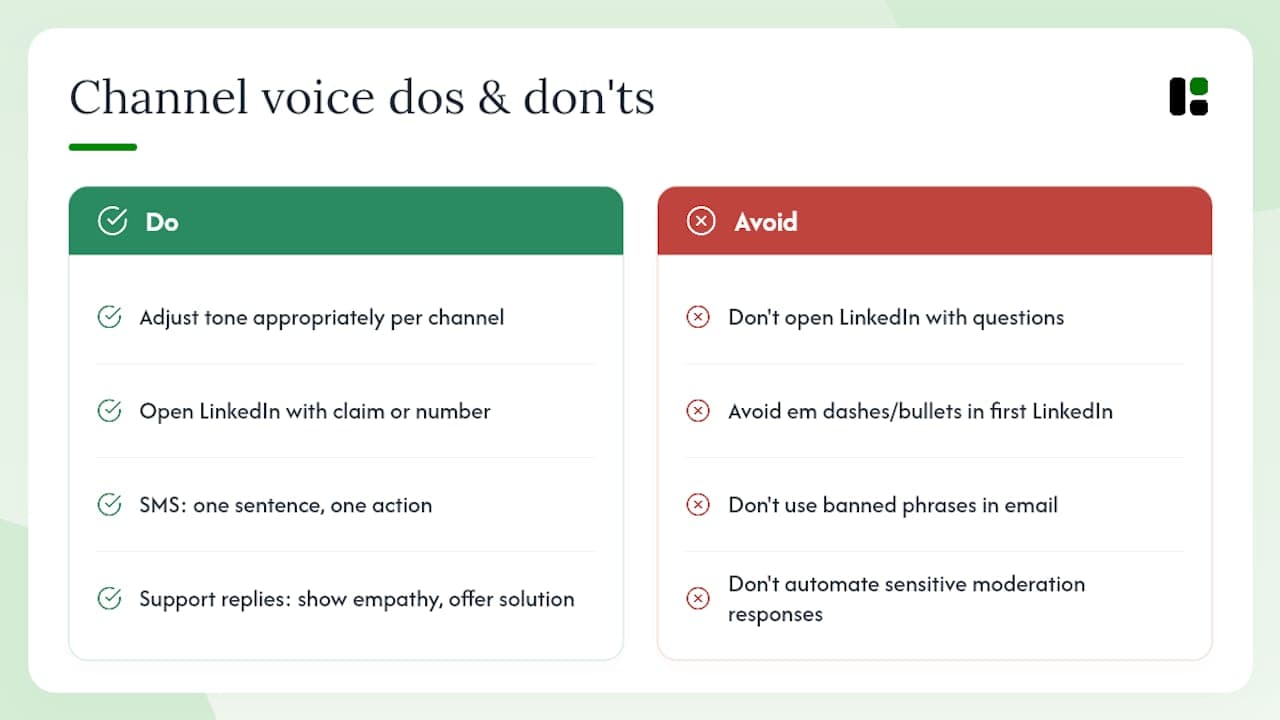
Support replies. Tone shifts to empathetic, but vocabulary rules and the ban on hedging language still apply. "I understand this is frustrating, and here is what we will do" is on-brand. "We apologize for any inconvenience this may have caused" is not.
Comment moderation. This is the highest-risk channel for AI-generated voice. Set a confidence threshold: any AI-drafted reply below a defined score goes to human review before posting. Never automate moderation responses on sensitive topics.
"Voice is your personality — it should be consistent across all touchpoints. Tone should shift appropriately based on context: more empathetic in customer support, more casual on social media, more professional in emails." — Mural's brand voice guide
Localization and multi-language voice
Translating a Voice Profile is not enough. Each language carries its own structural norms. A direct, short-sentence style that reads as confident in American English can read as rude in German or incomplete in French. Build a localized Voice Profile for each primary language: same pillars, adapted behavioral rules. The Body of Work for each locale should include native-language examples, not translated ones.
What goes into an AI-operable style guide and template library?
A style guide optimized for AI consumption is shorter and more specific than a traditional brand book. The goal is a document an AI can parse at generation time, not a PDF a new hire reads once and forgets.
Template examples
| Content type | Opening rule | Proof standard | CTA format |
|---|---|---|---|
| Blog intro | Lead with the direct answer or claim | Specific mechanism or sourced figure | Internal link to related resource |
| Product update | State the change first, then the reason | Feature name + what it does | "Try it now" with a direct link |
| Support reply | Acknowledge the issue, then the fix | Specific resolution step | Offer a follow-up if needed |
| LinkedIn caption | Concrete claim or specific number | One supporting detail | Question or link, not both |
Store these files where your AI tool can retrieve them at generation time: a prompt store, a CMS knowledge base, or a Git repository with a retrieval hook. AI design workflows that connect directly to a template library skip the retrieval step entirely because the voice is already encoded in the template.
Pro Tip: Keep the style guide under 1,500 words. A 40-page brand book is not a machine-readable artifact. Distill it to the rules that change AI output, and nothing else.
How do you govern, version, and update your brand voice artifacts?
Brand voice is a system, not a static document. Without governance, the Voice Profile drifts as individuals edit prompts locally, templates multiply without version control, and no one owns the canonical source of truth.
Content lifecycle workflow
Brief → AI draft → voice score → human review → publish. Each gate has a clear owner and a clear pass/fail criterion. The voice score step is where your QA rubric runs: does the output follow the vocabulary rules? Does the sentence rhythm match the pillar? A draft that fails the voice score goes back to the AI with a correction prompt, not straight to a human editor.
Role matrix
| Role | Responsibility |
|---|---|
| Voice Owner (Brand Manager) | Maintains canonical Voice Profile; approves all changes |
| Content Lead | Reviews AI drafts against voice score; escalates edge cases |
| Channel Manager | Applies channel-specific tone dials; flags new content types |
| Engineering/Ops | Manages prompt store, API integrations, and version control |
Versioning and rollback
Tag every Voice Profile update with a version number and a date. Keep deprecated versions in an archive folder, never deleted, so you can roll back if a new version degrades output quality. When you retire a template, mark it "deprecated" with a note explaining why, and link to the replacement.
"Governance, onboarding, editorial review, and an accountable owner are not optional extras — they are the components that close the gap between a voice guide and consistent outputs." — Rubicon on brand voice as a system
For privacy and compliance requests, maintain a deletion log: when an example is removed from the Body of Work (because it contains personal data or a deprecated claim), record what was removed, when, and why. One sentence in your governance doc is enough: "Any content example containing personal data or a retracted claim must be removed from all voice files within 48 hours of the request and logged in the deletion register."
How do you measure AI voice consistency and catch drift early?
Measurement turns a voice system from a creative aspiration into an operational asset. Consistent brand voice improves business outcomes and reduces review cycles when teams use tools that enforce style — but only if you track the right signals.
KPIs and reporting table
| Metric | Definition | Baseline | Current | Cadence |
|---|---|---|---|---|
| Voice match score | % of outputs passing QA rubric | Set at launch | Track weekly | Weekly |
| Sentence-length variation | Std. deviation of sentence lengths per piece | Measured from Body of Work | Track per batch | Monthly |
| Review time per asset | Minutes from AI draft to approved | Measured pre-system | Track weekly | Weekly |
| Publish velocity | Assets published per week | Pre-system baseline | Track weekly | Weekly |
| Engagement lift | Channel engagement vs. pre-system baseline | Pre-system average | Track monthly | Monthly |
Detecting and preventing voice drift
AI-driven voice drift is gradual. The model does not suddenly start sounding wrong; it slowly starts sounding like everyone else. The early signals are: banned phrases creeping back in, sentence length averaging out toward a generic 18-word mean, and concrete claims being replaced by vague superlatives.
Set automated guards: a script or linting rule that flags outputs containing banned phrases before they reach human review. Run the blind QA test quarterly against your original baseline outputs. If voice match score drops more than 10 percentage points from baseline, trigger a Voice Profile review.
- Review high-volume channels (LinkedIn, email) weekly.
- Run brand-level audits quarterly.
- Update the Voice Profile after any significant brand positioning change, not on a fixed calendar.
Why the "style guide" framing keeps failing marketing teams
Most teams treat brand voice as a document problem. They write a guide, share it in Notion, and assume the work is done. Three months later, the AI outputs sound generic, the guide is out of date, and no one is sure which version of the prompt template is canonical.
The real problem is that a style guide is a reference artifact. A voice system is an operational one. The guide tells you what the brand sounds like. The system makes the brand sound that way, every time, at scale, without relying on individual contributors to remember the rules.
What actually changes outcomes is the combination of machine-readable rules, a governed prompt store, a named owner, and a measurement cadence. Small teams can run this with a single Voice Profile and a weekly QA check. Larger organizations need the full role matrix and a versioned knowledge base. But both need the same foundation: voice defined as behavior, not personality.
The teams that get this right also tend to share one other habit: they update the Voice Profile when the brand positioning changes, not when the AI starts sounding wrong. Reactive updates are always too late.
assets dev gets your brand voice into production fast
Most teams spend weeks building prompt infrastructure before they ship a single on-brand asset. assets dev cuts that to hours. The platform reads your branding in seconds, encodes it into a curated template library, and generates images, videos, and PDFs that match your visual and verbal identity across LinkedIn, Instagram, Google, X, and Substack.
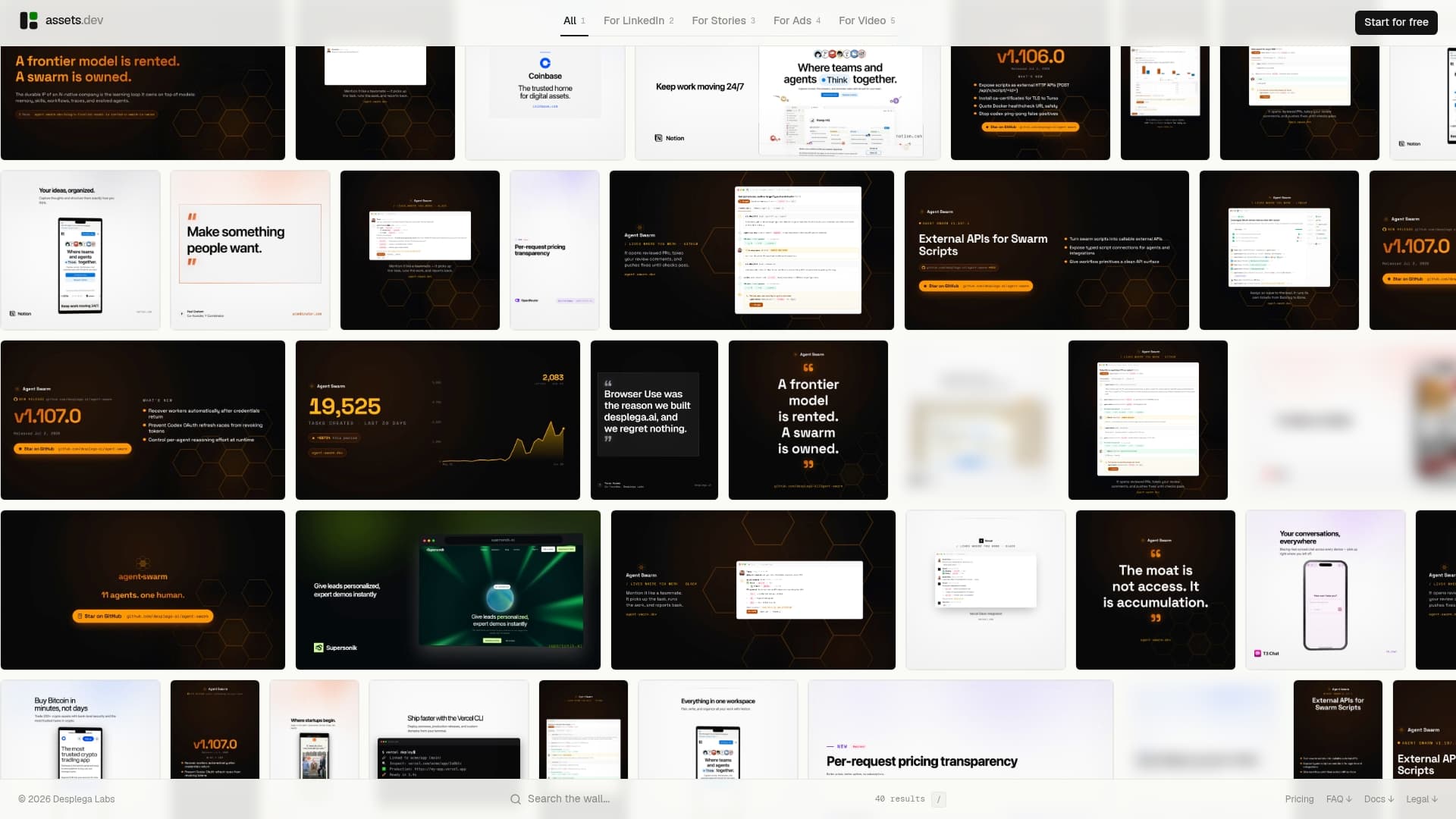
The API, CLI, and MCP integrations plug directly into your existing growth workflows, so brand-consistent assets generate automatically without manual prompt management. Every template is built for marketing growth assets specifically — no generic design tool sprawl, no prompt babysitting.
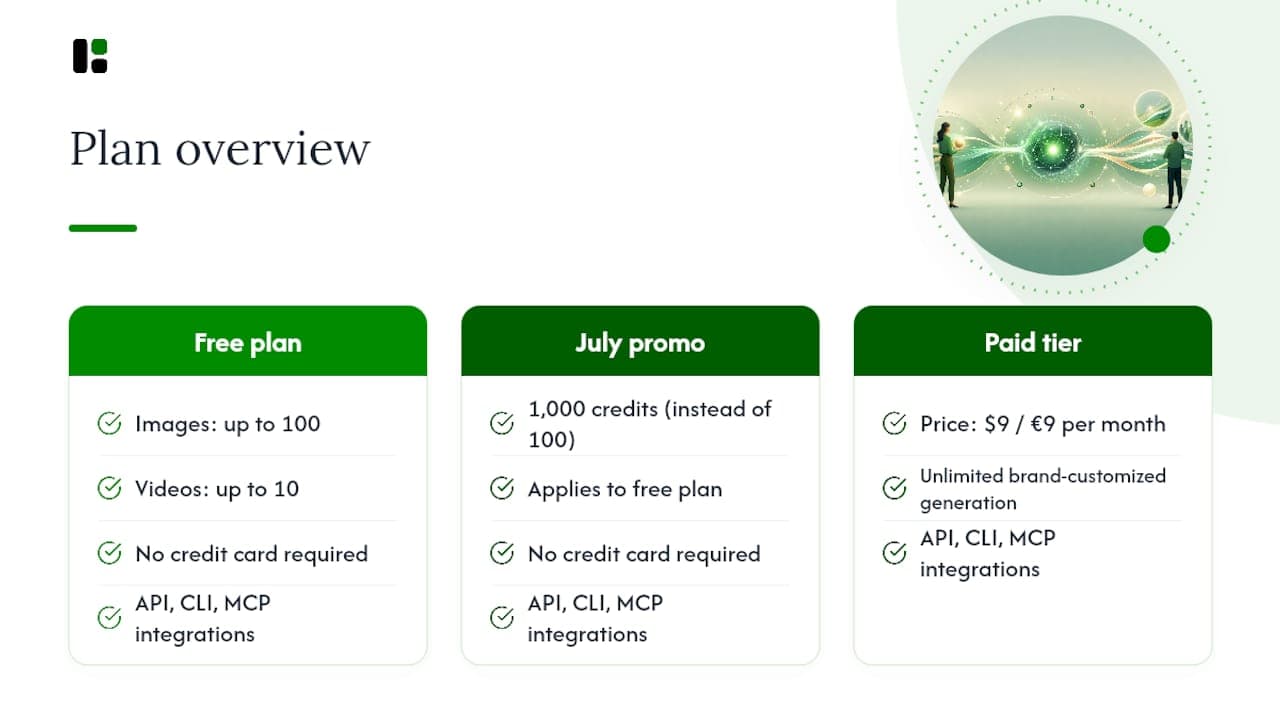
The free plan includes up to 100 image renderings or 10 videos with no credit card required. Teams signing up in July get 1,000 credits instead of 100. The only paid tier is $9/month (€9/month), which covers unlimited brand-customized generation for most marketing teams.
If you have been running AI content without a governed voice system, start with the free plan and run the blind QA test described in this article. The gap between your current output and your brand standard is the clearest argument for building the system now.
Useful sources
- Set up brand voice using AI
- How to create a brand voice guide for AI tools
- How to Build an AI Brand Voice System: Voice Profile, Body of Work, and Design Tokens | MindStudio
- brand voice consistency: the definitive guide
- Brand voice is a system, not a style guide -
- How to Maintain a Consistent Brand Voice—and Why | Grammarly Business
- Professionals are often surprised that while brand voice should remain stable, tone must remain flexible. Experts emphasize that the voice—your personality—should be consistent across all touchpoints, but the tone should shift appropriately based on context (e.g., more empathetic in customer support, more casual on social media, more professional in emails).
- assets.dev
FAQ
What is a Voice Profile in an AI brand voice system?
A Voice Profile is a structured document containing your brand's behavioral voice rules, vocabulary tables, and annotated examples. It loads as system context in AI workflows so every generation request follows the same brand constraints.
How is brand voice different from tone of voice?
Voice is your brand's stable structural identity — sentence rhythm, vocabulary, claim style. Tone is the situational adjustment you make per channel or scenario, such as more empathetic in support and more direct in ads.
How do you prevent AI-driven voice drift over time?
Run a blind QA test monthly: generate outputs with and without your Voice Profile loaded and score them against your voice pillars. Automated banned-phrase detection and quarterly brand-level audits catch drift before it reaches your audience.
Can assets dev handle brand voice for multiple channels at once?
Yes. assets dev encodes your brand rules into templates and generates images, videos, and PDFs for LinkedIn, Instagram, Google, X, and Substack through a single platform, with API and CLI integrations for automated pipelines.
How many examples do you need in a Body of Work?
Five to ten annotated examples are enough to teach an AI the principles behind your voice. Each example needs a one-sentence note explaining why it is on-brand — unannotated examples teach surface patterns, not the underlying rules.