Field note
9 Proven Ad Hook Templates for Marketers and Creators
Discover 9 powerful ad hook templates that drive success in social media marketing. Boost your campaigns with proven techniques!
The nine ad hook templates that dominate paid social are: Sale, In-30-Seconds, Ever-Tried/Noticed, Curiosity/Secret, Personal/Founder Story, Why-Would-You-Ever, Hero SKU/Now-Available, Best-Savings, and Social Proof. According to hand-tagging of 4,994 active DTC ads, these nine hooks account for roughly 70% of the Meta feed. That means most of what's working isn't mysterious — it's repeatable.
Here are three you can copy right now:
- Sale: "Get [Product] for [X]% off — today only." Best for catalog brands with a clear price advantage.
- In-30-Seconds: "I'll show you how to [solve problem] in 30 seconds." Best for education-heavy or demonstration products.
- Ever-Tried/Noticed: "Have you ever noticed that [relatable frustration]?" Best for mid-consideration audiences who recognize the problem but haven't committed to a solution.
The rest of this article gives you the full template library organized by psychological mechanism, a fast A/B test protocol, platform-specific pacing rules, and a prioritized list of which hooks to test first. MakeHooks research shows that hook rate (3-second views divided by impressions) directly correlates with delivery cost, so getting the hook right isn't just a creative preference. It's a budget decision. assets dev is the recommended production path throughout for teams who need to ship variants fast.
Key Takeaways
The fastest path to better ad performance is picking one of the nine proven hook mechanisms, shipping five variants with identical post-hook creative, and measuring hook rate before anything else.
| Point | Details |
|---|---|
| Nine hooks cover most of the feed | BrandMov's analysis of 4,994 DTC ads found nine hooks account for ~70% of Meta creative. |
| Hook rate is your first metric | A hook rate above 45% is strong; above 60% is exceptional, per MakeHooks benchmarks. |
| Test protocol: one variable only | Run 4–5 hook variants with identical post-hook creative; judge at 1,000+ impressions per variant. |
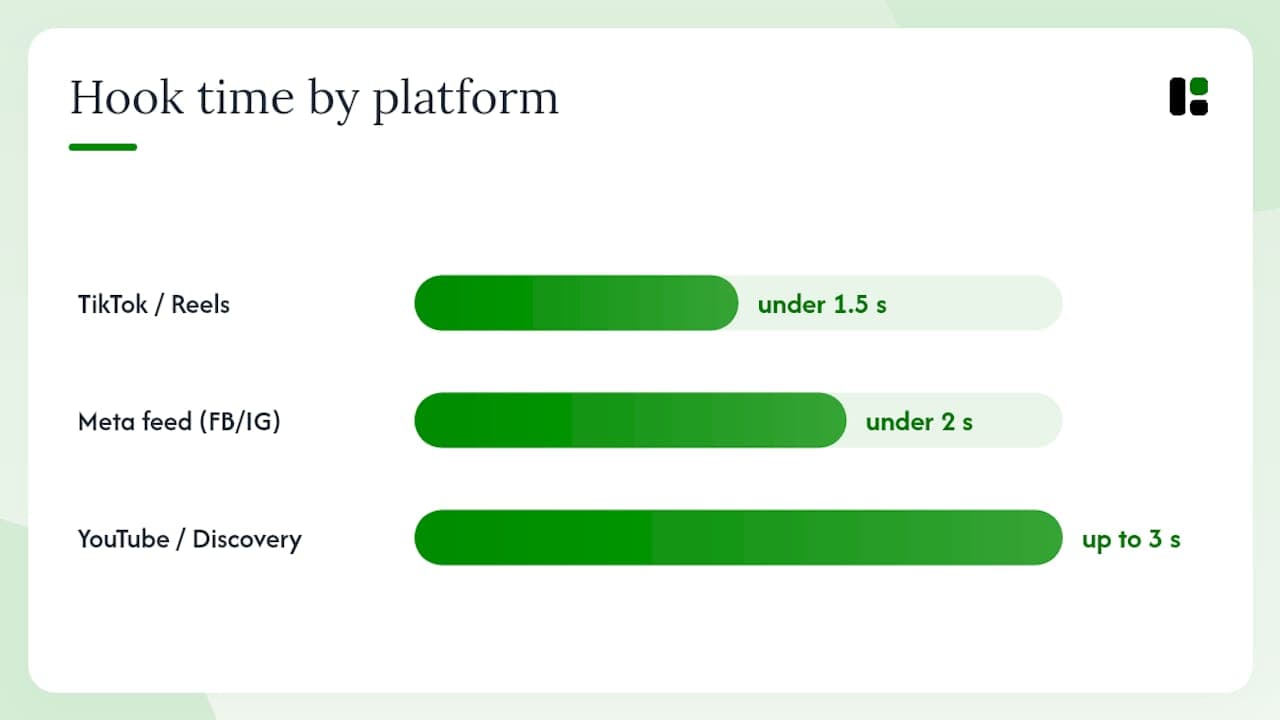
| Platform pacing is non-negotiable | TikTok/Reels under 1.5s, Meta feed under 2s, YouTube under 3s — text overlay required for sound-off. |
| assets dev speeds up variant production | Use assets dev's template library and batch render to ship 20+ hook variants in a single session. |
Table of Contents
- What are the best ad hook templates by psychological mechanism?
- How do you test ad hooks systematically?
- How should you adapt hooks for each platform?
- Why do most hooks fail, and how do you fix them?
- Which nine hooks dominate DTC creative, and when should you test each?
- How do you customize hook templates and scale production?
- Legal and ethical considerations in crafting ad hooks
- What actually separates teams that win with hooks from those that don't
- Ship hook variants faster with assets dev
- Sources
- FAQ
What are the best ad hook templates by psychological mechanism?
A taxonomy of 40 hooks organized by mechanism makes one thing clear: the goal isn't to copy a line verbatim. It's to match the psychological trigger to your audience's exact state of mind, then write in their language.
Curiosity
Formula: "The [unexpected truth / secret] about [topic] that [audience] never talks about."
- B2C: "The skincare ingredient dermatologists quietly recommend but never advertise."
- B2B/LinkedIn: "The pricing strategy SaaS founders avoid — and why it's costing them renewals."
- First-frame suggestion: Bold text overlay on a plain background. No product visible yet.
Works best for: premium, education-heavy, and disruptor brands where the audience thinks they already know the answer.
Pattern interrupt
Formula: "[Unexpected visual or statement] — wait, let me explain."
- B2C: "I threw away my $300 moisturizer. Here's what replaced it."
- B2B/LinkedIn: "We fired our agency. Retention went up."
- First-frame suggestion: Start mid-action (product being tossed, screen being closed). No logo, no intro.
Works best for: brands competing in crowded categories where the feed looks identical.
Direct address / problem
Formula: "If you [have this problem], this is for you."
- B2C: "If your back hurts every morning, watch this."
- B2B/LinkedIn: "If your team is still building decks manually, there's a faster way."
- First-frame suggestion: Close-up of the pain point (a person wincing, a messy spreadsheet).
Works best for: services and supplements where the pain is visceral and specific.
Social proof / authority
Formula: "[Number] [people / customers / experts] [did X / say Y]."
- B2C: "47,000 women switched to this deodorant last month."
- B2B/LinkedIn: "Three YC-backed teams use this exact workflow."
- First-frame suggestion: A counter or review screenshot filling the frame.
Works best for: mid-to-late funnel, catalog brands, and any offer where trust is the barrier.
Urgency / consequence
Formula: "If you don't [do X] before [deadline/event], [negative outcome]."
- B2C: "If you're not using SPF daily, you're undoing everything else."
- B2B/LinkedIn: "Miss this quarter's window and you'll wait another 12 months."
- First-frame suggestion: A clock, a calendar, or a before/after split.
Works best for: seasonal offers, time-limited sales, and health/compliance categories.
Founder / story
Formula: "I [struggled with / discovered / built] [X] because [personal reason]."
- B2C: "I spent $4,000 on supplements before I figured out what actually worked."
- B2B/LinkedIn: "I built this tool because I was the person doing it manually at 11 PM."
- First-frame suggestion: Founder on camera, mid-sentence, no intro card.
Works best for: early-stage brands, premium products, and any offer where trust is built through identity.
Product news / hero SKU
Formula: "Introducing [Product] — the [category] that [specific claim]."
- B2C: "Introducing the only sunscreen that disappears on dark skin tones."
- B2B/LinkedIn: "Meet the API that cuts your render time by half."
- First-frame suggestion: Product reveal with bold name overlay.
Works best for: new launches, reformulations, and catalog expansions.
Sale / best savings
Formula: "Our biggest [sale / deal] of the year starts now — [specific offer]."
- B2C: "40% off everything. No code needed. Ends Sunday."
- B2B/LinkedIn: "Annual plan, monthly price. This week only."
- First-frame suggestion: Price or percentage in large type, centered.
Works best for: catalog brands with competitive pricing and any audience already in the consideration phase.
| Mechanism | Best-fit category | Typical angle |
|---|---|---|
| Curiosity | Premium, education-heavy | Disruptor / contrarian |
| Pattern interrupt | Crowded catalog | Shock / unexpected |
| Direct address | Services, supplements | Pain-first |
| Social proof | Mid-funnel, catalog | Authority / volume |
| Urgency | Seasonal, compliance | Consequence |
| Founder story | Early-stage, premium | Identity / trust |
| Product news | New launches | Announcement |
| Sale / savings | Catalog, competitive price | Deal-first |
Pro Tip: For sound-off environments (most of Meta and LinkedIn), the first-frame text overlay carries the entire hook. Write it as a complete thought — not a teaser — so a viewer who never turns on audio still gets the point.
How do you test ad hooks systematically?
The recommended protocol is clean: run 4–5 hook variations where everything after the first 2–3 seconds is identical. The hook is the only variable. Here's how to run it:
- Pick one offer and one audience segment. Don't test hooks across different products or cold vs. warm audiences simultaneously. You'll conflate variables.
- Write 4–5 hooks from different mechanisms (e.g., curiosity, social proof, sale, founder story, direct address). Keep the post-hook creative — the body of the video or the ad copy below the fold — word-for-word identical.
- Set equal budgets per variant and launch them simultaneously. Staggered launches skew results because platform algorithms favor recency.
- Wait for at least 1,000 impressions per variant before drawing conclusions. Judging at 200 impressions is noise, not signal.
- Measure hook rate first (3-second views divided by impressions). According to MakeHooks, under 30% is weak, 30–45% is average, 45–60% is strong, and 60%+ is exceptional. Then layer in CTR and cost per result.
- Kill the bottom two performers at day 3–4 if the gap is clear. Let the top two run to day 7 for a clean signal.
- Pick the winner and write 10–20 variants of that mechanism before testing a new one.
Pro Tip: Hold the landing page constant too. A hook that promises "30 seconds to fix X" needs a landing page that opens with the same promise. Hook-to-page mismatch is one of the most common reasons a strong hook still produces a weak CPA.
How should you adapt hooks for each platform?
Platform pacing research is consistent: the first 1–3 seconds are decisive, and the window shrinks on faster-scroll surfaces. Here's how to adapt the same hook template per platform:
-
TikTok / Reels: Hook must land in under 1.5 seconds. Start mid-action or mid-sentence. No logo, no music fade-in, no intro card. Bold center text in the first frame. Aspect ratio: 9:16. Sound-on is more common here than on Meta, but text still matters. Example first frame: "I stopped using [product] for 30 days — here's what happened" in large white text over a close-up face.
-
Meta feed (Facebook / Instagram): Under 2 seconds. Sound-off is the default. The first-frame text overlay is your hook. Square (1:1) or vertical (4:5) outperforms landscape. Example: "47,000 people switched" in bold over a product shot.
-
YouTube / Discovery: You have up to 3 seconds before the skip button appears. Use that window for a direct-address or curiosity hook spoken on camera. Landscape (16:9) is standard. Example: "Before you buy another [category product], watch this."
-
LinkedIn: Slower scroll, more professional context. A pattern-interrupt or founder-story hook works well. Start with a bold claim in the caption's first line (LinkedIn truncates after two lines). Aspect ratio: 1:1 or 4:5 for video. Example caption opener: "We cut our content production time by 80%. Here's the exact workflow."
-
Google Display / Responsive: The hook lives in the headline (30 characters max). Lead with the benefit or the offer, not the brand name. Example: "Fix [Problem] in 30 Seconds."
Visual and verbal pairing consistently outperforms either alone. A fast zoom or flash cut paired with a 1–2 word overlay encodes the hook's payoff before the viewer consciously processes it.
Pro Tip: Build a vertical-first (9:16) master cut. Crop to 1:1 for Meta feed and 16:9 for YouTube by repositioning the subject in the frame, not by letterboxing. The first-frame text must stay fully visible in every crop.
Why do most hooks fail, and how do you fix them?
Most hook failures come down to a handful of repeatable mistakes. Recognizing them before launch saves real money.
- Slow intro: The first 2 seconds show a logo, a product beauty shot, or a music sting. Fix: cut everything before the hook. Start on the claim or the action.
- Clever but unclear: The hook is witty but the viewer can't tell what's being sold. Fix: add one concrete noun. "This changed my mornings" becomes "This changed my skincare routine."
- Hook-to-page mismatch: The ad promises a specific offer or outcome; the landing page opens with brand story. Fix: match the first sentence of the landing page to the hook's core promise.
- Overstated claims: "Guaranteed results in 24 hours" or "clinically proven" without substantiation. Fix: use social proof numbers or conditional language ("worked for 12,000 customers") instead of absolute guarantees.
- Wrong format for the platform: A 16:9 video running as a TikTok with black bars, or a text-heavy static ad on a sound-on surface. Fix: check aspect ratio and sound assumptions before trafficking.
Pre-launch checklist:
- Does the hook land a clear, specific point within 3 seconds?
- Does the landing page open with the same promise the hook makes?
- Are all claims (discounts, results, endorsements) substantiated and compliant with FTC guidelines on advertising disclosures?
- Is the aspect ratio correct for the placement?
- Does the first-frame text read clearly on a phone screen at arm's length?
Which nine hooks dominate DTC creative, and when should you test each?
BrandMov's analysis of 4,994 hand-tagged DTC ads found that nine hooks account for roughly 70% of the Meta feed, with four hooks (sale, in-30-seconds, ever-tried/noticed, and feature-breakdown) making up the largest share. That's the priority list.
- Sale — Test first when your price is competitive. Works across nearly every catalog category.
- In-30-Seconds — Test when your product requires demonstration or education. Crowded categories where "how it works" is the barrier.
- Ever-Tried/Noticed — Test for mid-consideration audiences. The viewer already knows the problem; this hook confirms you understand it too.
- Feature-Breakdown — Test when a specific feature is the differentiator. Works well for SaaS, supplements, and tech hardware.
- Social Proof — Test when volume or authority is your strongest asset. Especially effective post-launch once reviews accumulate.
- Curiosity/Secret — Test for premium or education-heavy brands where the audience thinks they already know the answer.
- Founder/Story — Test for early-stage brands or when trust is the primary barrier to conversion.
- Urgency/Consequence — Test for seasonal offers, limited inventory, or compliance-driven categories.
- Hero SKU/Now-Available — Test at launch or reformulation. Strong for new product lines entering a known category.
Nova Pixel's template research maps these same nine to psychological drivers, confirming the priority order holds across industries. Start with Sale and In-30-Seconds. They have the broadest applicability and the most creative precedent to learn from.
How do you customize hook templates and scale production?
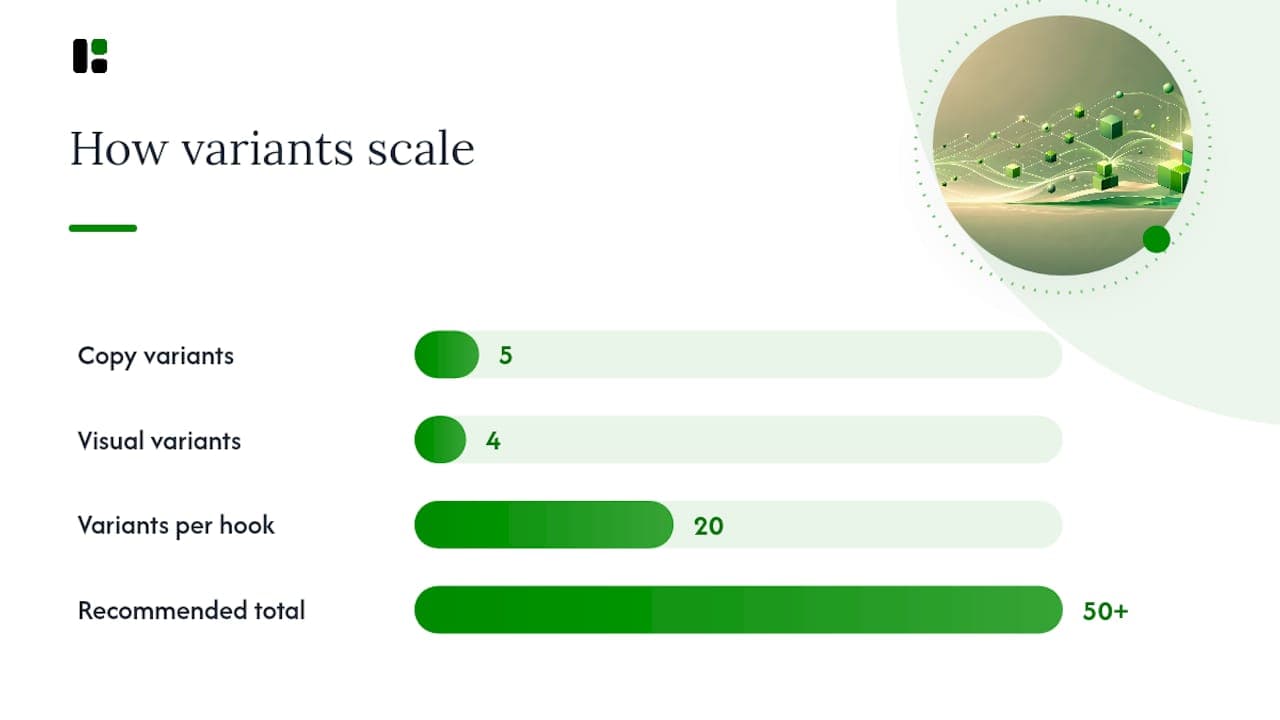
The most successful teams don't keep testing new mechanisms indefinitely. They find one that works and ship 50+ variants of it. Here's the workflow:
- Pick your priority hook from the nine above based on your offer type and audience stage.
- Write 5 copy variants of that hook. Vary the specific noun, the number, the tone (direct vs. playful), and the audience address ("you" vs. "anyone who").
- Create 4 motion or visual variants per copy line: different first-frame visuals, different text overlay styles, different talent or product angles.
- Ship all variants simultaneously to the same audience slice with equal budgets.
- Pick the winner at day 7 and write 10–20 derivatives before moving to the next mechanism.
Brand-voice checklist before writing variants:
- Does the hook use vocabulary your audience actually uses (not marketing speak)?
- Is the tone consistent with your brand's acceptable range (irreverent, authoritative, warm)?
- For founder/story hooks: is the personal detail specific enough to be credible, and does it stay within what you can substantiate?
- Does the hook work without the brand name? (It should — the brand earns attention after the hook lands.)
For scaling, naming conventions matter. Label each variant with the mechanism, the copy variant number, and the visual variant number (e.g., SALE-C2-V3). This makes ad ops reporting readable and lets you spot patterns across hundreds of variants.
Automated video creation workflows and video synthesis API integrations make batch rendering practical for small teams. assets dev's brand preset system learns your visual identity in seconds and applies it across every render, so variant 47 looks as on-brand as variant 1. The psychology behind service marketing also applies here: hooks that tap into a specific emotional driver consistently outperform generic benefit statements, regardless of how polished the production is.
Legal and ethical considerations in crafting ad hooks
The FTC's endorsement and testimonial guidelines apply directly to ad hooks. A hook that says "I lost 30 pounds in 30 days" is a testimonial, and it requires a disclosure if the result isn't typical. "Clinically proven" requires substantiation from actual clinical evidence. "Guaranteed" in a hook creates a legal obligation you have to honor.
A few practical rules:
- Substantiate superlatives. "The best" and "the only" require evidence. "One of the most popular" is safer and usually just as effective.
- Disclose material connections. If a founder hook features a paid spokesperson, that relationship must be disclosed per FTC guidelines.
- Match the hook to the actual offer. A hook that promises 50% off when the sale is 20% off is deceptive advertising, not just a creative mismatch.
- Avoid urgency that isn't real. "Ends tonight" for an offer that resets every night is a dark pattern the FTC has specifically flagged.
- Sensitive categories need extra care. Health claims, financial results, and before/after comparisons all carry heightened scrutiny. State results as individual outcomes, not guarantees.
This is general guidance, not legal advice. Confirm your specific claims with a qualified advertising attorney before running at scale.
What actually separates teams that win with hooks from those that don't
Most teams treat hook testing as a creative exercise. The ones who consistently improve their hook rate treat it as a measurement problem. The difference shows up in how they set up the test, not just what they write.
The teams at Desplega Labs run a tight cadence: pick one priority hook from the nine, write five variants in a single session, keep everything after the 2-second mark identical, and ship simultaneously. The first signal usually arrives within 72 hours on Meta. By day 7, there's almost always a clear leader. The winning mechanism then gets 10–20 derivatives before the team touches a new hook type.
What's counterintuitive is how rarely the "clever" hook wins. The direct-address and sale hooks outperform curiosity hooks more often than creative teams expect, especially for cold audiences who have no prior brand context. Curiosity hooks tend to win in retargeting, where the viewer already knows the brand and is looking for a reason to come back.
The other thing worth saying plainly: a great hook on a weak landing page is a wasted test. The hook rate will look strong, the CTR will look decent, and the CPA will still disappoint. The hook earns the click. The page earns the conversion. Both have to be right.
Ship hook variants faster with assets dev
Writing five hook variants is the easy part. Rendering them across formats, applying brand presets, and trafficking them to four platforms in the same day is where most small teams lose time.
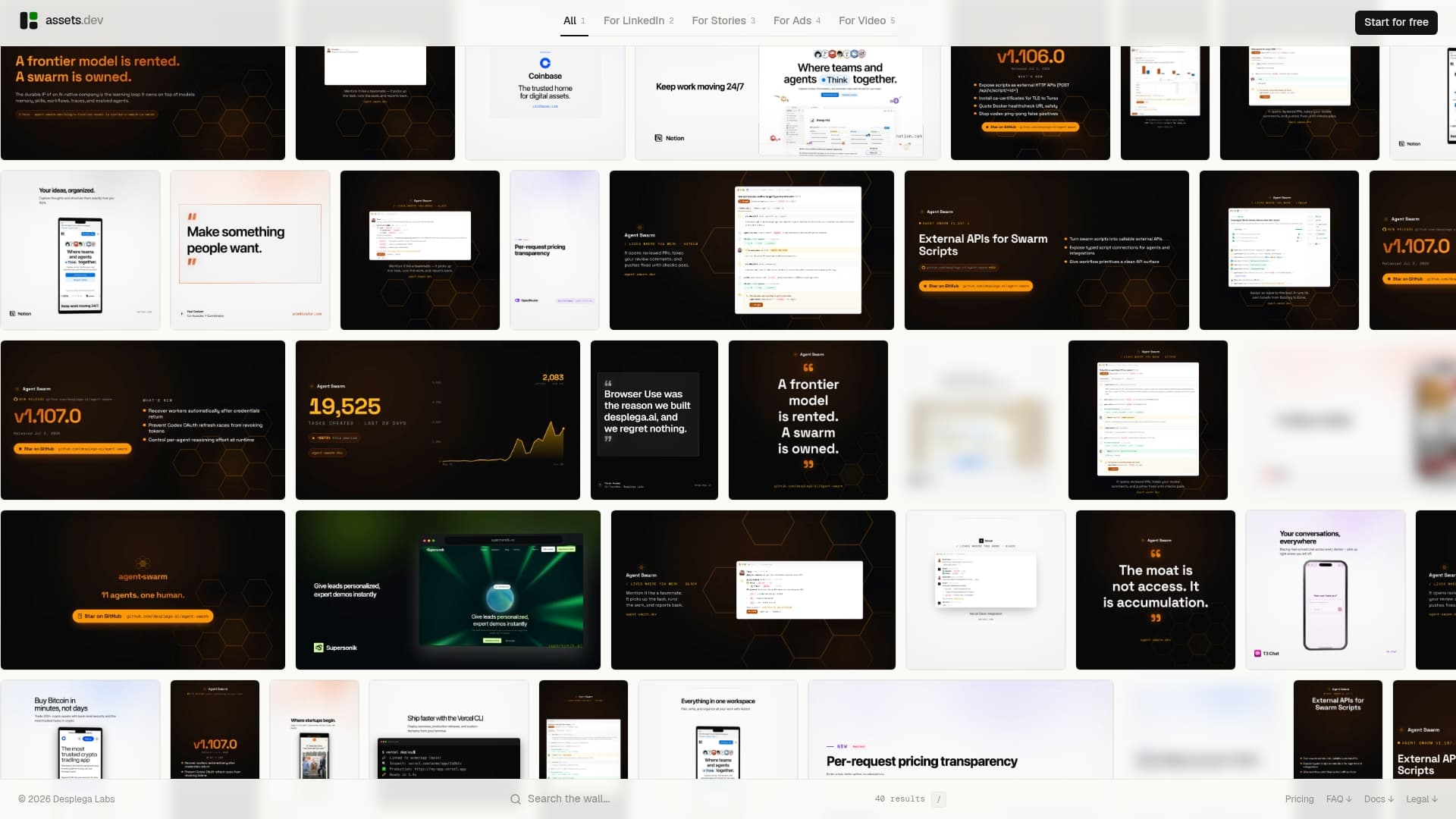
assets dev is built for exactly that workflow. You pick a hook template from the curated library, apply your brand preset (the system learns your visual identity in seconds), and batch-render image, video, and PDF variants in one pass. The MCP integration plugs directly into your automated growth flows via CLI, API, or MCP, so variant generation can run without a designer in the loop. A small team can realistically ship 20 hook variants across LinkedIn, Instagram, and Google in a single afternoon.
The free plan includes up to 10 video renders or 100 image renders, no credit card required. The pro plan is $9/month (€9/month as listed). In July, the free plan comes with 1,000 credits instead of the standard 100. Start at Assets and run your first hook test today.
Sources
The sources below back the research in this article and are worth bookmarking for ongoing hook testing and platform guidance:
- The Ultimate Ad Hook Library: 40 Proven Hooks + Example Angles by Industry
- Best Performing Ad Hooks
- Scroll Stopping Hooks for Ads | Free Scroll Stopping Hook Generator | MakeHooks
- Scroll-Stopping Hook Ideas (Visual + Verbal) - Community
- 9 Proven Meta Ad Hooks to Stop the Scroll and Boost Sales | Nova Pixel Insights
FAQ
What is a hook rate and why does it matter?
Hook rate is the percentage of impressions that result in a 3-second view. According to MakeHooks, a rate above 45% is strong and above 60% is exceptional. Higher hook rates correlate with lower delivery costs because platforms reward content that retains viewers past the critical early window.
How many hook variants should you test at once?
Run 4–5 variants simultaneously with equal budgets. Keep everything after the first 2–3 seconds identical so the hook mechanism is the only variable. Judge results after at least 1,000 impressions per variant.
Which ad hook template works best for cold audiences?
Sale and direct-address hooks tend to outperform curiosity hooks on cold audiences because they deliver immediate, concrete value without requiring prior brand familiarity. Test Sale and In-30-Seconds first for cold traffic.
How do you adapt a hook template for LinkedIn vs. TikTok?
On TikTok, the hook must land in under 1.5 seconds, starting mid-action with bold center text. On LinkedIn, lead with a bold claim in the first two lines of caption copy and use a 1:1 or 4:5 video format. The psychological mechanism can be the same; the pacing and format must match the platform.
Can assets dev help generate hook variants automatically?
Yes. assets dev's template library, brand preset system, and MCP integration let teams batch-render image and video hook variants with brand-consistent styling applied automatically, without a designer in the loop for each asset.