Field note
Best Bannerflow Alternatives in 2026 for Ad Scaling
Discover the best Bannerflow alternatives in 2026. Explore tools like Abyssale and Celtra for effective ad scaling and automation.
TL;DR:
- The best Bannerflow alternatives in 2026 include Abyssale, Zuuvi, and AdCreative.ai for automation and creative intelligence.
- Enterprise teams prefer Celtra for comprehensive management, while smaller teams benefit from Canva or Assets for quick, branded assets.
What are the best Bannerflow alternatives right now?
The strongest Bannerflow alternatives in 2026 are Abyssale, Celtra, Zuuvi, and Quickads for teams that need real creative automation. Canva and PosterMyWall cover the budget end. Extuitive and AdCreative.ai sit in the middle, pushing AI-driven creative intelligence over raw volume. The right pick depends almost entirely on whether you need enterprise workflow control, pure automation speed, or a lighter tool that gets out of your way.
| Platform | Best For | Key Features | Automation & AI | Pricing & Plans | Scalability |
|---|---|---|---|---|---|
| Abyssale | Ad production automation | Template automation, design editor | AI generation from structured data | Tiered plans | High |
| Celtra | Enterprise creative management | DAM, workflow automation, analytics | Strong workflow AI | — | Enterprise |
| Zuuvi | Performance-focused marketers | DCO, AI insights, ad performance | Deep DCO and AI | Tiered plans | High |
| Brandeploy | Multichannel brand consistency | Brand content management, approvals | Multichannel sync | Tiered plans | Medium-High |
| Extuitive | Data-driven creative teams | Creative intelligence, automation | Predictive scoring | Tiered plans | Medium-High |
| SnapShark | High-volume asset generation | API-first, visual asset output | Full API automation | Tiered plans | Very High |
| The Brief | Brief and approval workflows | Brief management, collaboration | Workflow automation | Tiered plans | Medium |
| PosterMyWall | Small teams, quick visuals | Template library, sharing tools | Basic | Freemium | Low-Medium |
| Quickads | End-to-end AI ad generation | AI creative generation, ideation | Full automation | Tiered plans | High |
| AdCreative.ai | AI-optimized creative testing | ROI-focused AI, creative testing | AI-fueled testing | Tiered plans | High |
| Canva | Budget-conscious small teams | Broad templates, easy editor | Basic AI tools | Freemium + paid | Low-Medium |
Here is where each platform actually fits:
- Abyssale: Best when your team needs to generate hundreds of banner variants from a data feed without manual design work.
- Celtra: The go-to for large enterprises that need brand governance, DAM, and deep analytics baked into one platform.
- Zuuvi: Built for performance marketers who want dynamic creative optimization tied directly to campaign data.
- Brandeploy: Strong choice for brands managing ads, social, and web visuals that must stay visually consistent.
- Extuitive: Focuses on creative intelligence, not just speed. Useful when you want to know why a creative works before scaling it.
- SnapShark: Pure API-driven asset generation. No campaign management, just fast, automated visual output at volume.
- The Brief: Solves the brief-to-approval bottleneck. Less about production volume, more about keeping creative teams organized.
- PosterMyWall: Simple, fast, and free to start. Works for social posts and event graphics; not built for programmatic ad campaigns.
- Quickads: Automates the full creative cycle from concept to finished ad using AI, with minimal manual input.
- AdCreative.ai: Generates and tests ad creatives with ROI optimization built in, useful for teams running paid social at scale.
- Canva: The freemium design option for teams on tight budgets. Lacks enterprise automation but covers basic ad design well.
How do these platforms actually compare on features and workflow?
Bannerflow built its reputation on display ad creation and real-time collaboration. Its core strengths include ease of use, ad personalization, multichannel support, and a solid template library. The alternatives each carve out a different slice of that territory.

Design tools and workflow collaboration split the field quickly. Celtra goes deepest here, with digital asset management, structured approval workflows, and analytics that enterprise teams actually use. The tradeoff is cost: Celtra is priced at a premium level, making it less suitable for most mid-market teams. Abyssale takes a different approach, pairing a design editor with data-driven automation so teams can generate large volumes of banner variants from structured inputs without rebuilding each one manually.
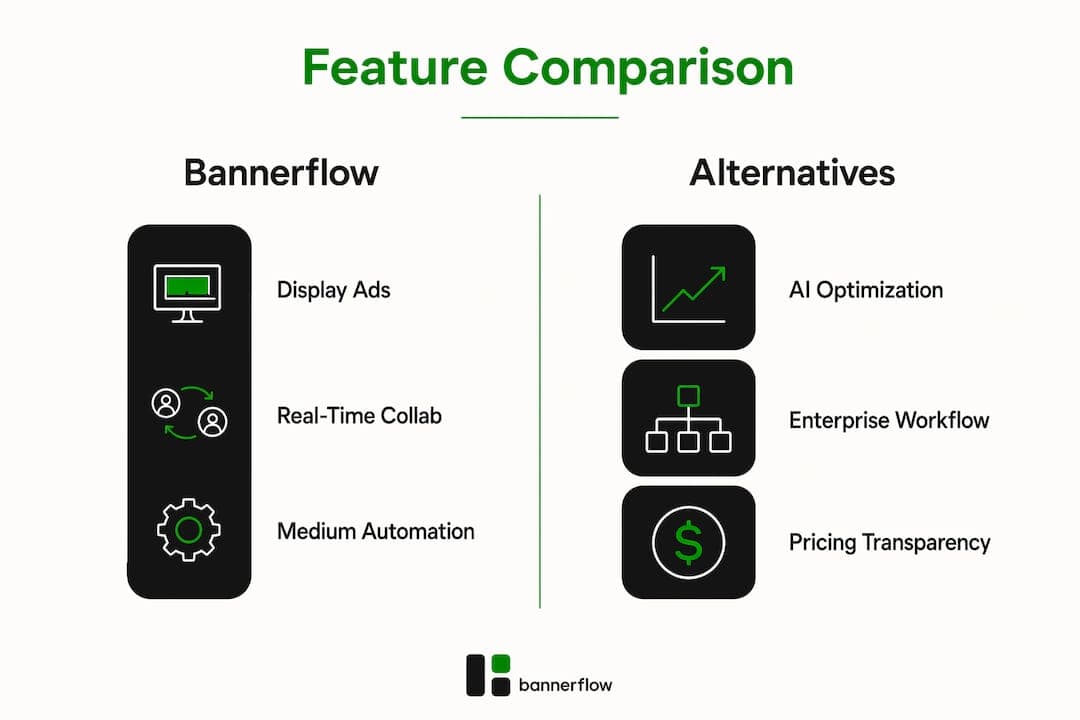
Automation and AI is where the real differentiation lives in 2026. Zuuvi uses dynamic creative optimization to connect ad performance data back to creative decisions, which is genuinely useful for performance marketers running A/B tests at scale. Quickads and AdCreative.ai both lean into full-cycle AI generation, where the platform handles ideation, production, and optimization with minimal human input. SnapShark sits at the extreme end: it is API-first automation with no campaign management layer, built for teams that need raw asset generation speed above everything else.
Pricing transparency varies widely. Canva and PosterMyWall provide free starting options accessible to smaller teams. Bannerflow uses custom pricing, which makes direct cost comparison difficult. Celtra's pricing positions it as an enterprise-level solution. Most mid-tier alternatives use tiered pricing plans, although exact prices are not always disclosed.
Scalability favors Abyssale, Zuuvi, SnapShark, and AdCreative.ai for high-volume campaigns. Brandeploy scales well across channels rather than pure volume, making it the better fit when brand consistency across touchpoints matters more than raw output speed. The Brief and PosterMyWall are not built for enterprise-scale programmatic campaigns.
Key tradeoffs worth knowing before you commit:
- Celtra gives you the most complete enterprise feature set but requires budget and onboarding time to match.
- Zuuvi's DCO capabilities are strong, but the platform is most valuable when you already have campaign performance data to feed it.
- Canva is genuinely good for simple ad design. It is not a Bannerflow replacement for teams running complex display campaigns.
- SnapShark's API model means your team needs technical resources to get value from it.
What do real users say about these platforms?
User feedback on creative management platforms tends to cluster around three themes: ease of use, support quality, and whether the pricing feels fair once you are inside the platform.
Feedback on Bannerflow alternatives consistently highlights that ease of use and reliable support are decisive factors in whether teams actually adopt a new platform. A tool with strong automation that takes three months to learn often loses to a simpler one that teams use on day one.
Common positives users report across the top alternatives:
- AI-driven generation that cuts production time for repetitive banner variants.
- Template libraries that give non-designers a real starting point.
- Multichannel publishing that reduces the need to reformat assets manually.
Common frustrations:
- Pricing that is not transparent upfront, especially at the enterprise tier.
- Onboarding that requires dedicated support but does not always get it.
- Freemium tiers that are useful for testing but hit limits quickly for real campaign work.
Celtra users on G2 note the platform's depth for enterprise workflows, while also flagging that smaller teams can find it complex to configure. Canva users consistently praise its simplicity but acknowledge it is not designed for programmatic ad management. Zuuvi earns positive marks from performance marketers who want creative decisions tied to data, not just intuition.
How do you switch from Bannerflow to a new platform?
Switching creative platforms mid-campaign is one of the riskier moves a marketing team can make. A structured approach keeps campaigns running while you migrate.
- Audit your current setup. List every active campaign, template, and integration running in Bannerflow. Know exactly what you are moving before you touch anything.
- Define your requirements. Decide whether your priority is automation depth, pricing, multichannel support, or workflow collaboration. This narrows the field fast.
- Run a parallel pilot. Choose one campaign or creative set and run it through your chosen alternative while Bannerflow stays live. This surfaces integration gaps without risking live campaigns.
- Map your integrations. Check whether your new platform connects to your existing marketing stack: your DSP, CRM, analytics tools, and any content management systems. SnapShark's API model, for example, requires technical integration work that Canva does not.
- Migrate templates and assets. Export creative assets from Bannerflow and rebuild or import them into the new platform. Prioritize your highest-traffic templates first.
- Train your team. Allocate time for hands-on training before the full cutover. Platforms like Celtra have steeper learning curves than PosterMyWall or Canva.
- Transfer analytics tracking. Reconfigure UTM parameters, conversion pixels, and any attribution tracking so you do not lose campaign performance data during the switch.
- Go live and monitor closely. Cut over fully and watch performance metrics daily for the first two weeks. Have a rollback plan ready if something breaks.
Pro Tip: Run your creative automation pilot on a campaign with a defined end date. That gives you a clean before-and-after performance comparison without the pressure of an open-ended test.
What actually makes a Bannerflow alternative worth using?
The difference between a useful creative platform and an expensive one comes down to whether automation produces smarter assets or just more of them. Volume is easy. Producing creatives that actually perform is harder.
Smart creative automation means using data to predict which creative will work before you spend budget finding out. Platforms like Extuitive and AdCreative.ai build this into their core workflow. Zuuvi's DCO connects creative decisions to live campaign signals. That is a fundamentally different model than simply generating 500 banner variants from a template.
Features that separate genuinely effective platforms from the rest:
- AI-based message testing before launch, not just after. Predictive creative intelligence lets teams refine messaging before spending media budget.
- Data-driven creative optimization that adjusts which variant runs based on real performance signals.
- Multichannel content synchronization so a campaign update propagates across display, social, and web without manual reformatting.
The shift from volume to intelligence is what separates the platforms worth paying for from the ones that just automate repetitive work. A team that produces 50 well-tested creatives will usually outperform one that produces 500 untested variants. Platforms like Abyssale and SnapShark are excellent at volume. Extuitive, Zuuvi, and AdCreative.ai are built for the intelligence layer. The best choice depends on where your current bottleneck actually sits.
For teams managing content marketing automation at scale, pairing a strong creative platform with a solid content operations layer compounds the efficiency gains significantly.
Assets is worth a look if you want templates without the overhead
If the platforms above feel like more infrastructure than your workflow needs, Assets takes a different approach. It is a growth marketing template platform built specifically for teams that want high-quality, brand-consistent assets without managing a full creative management system.
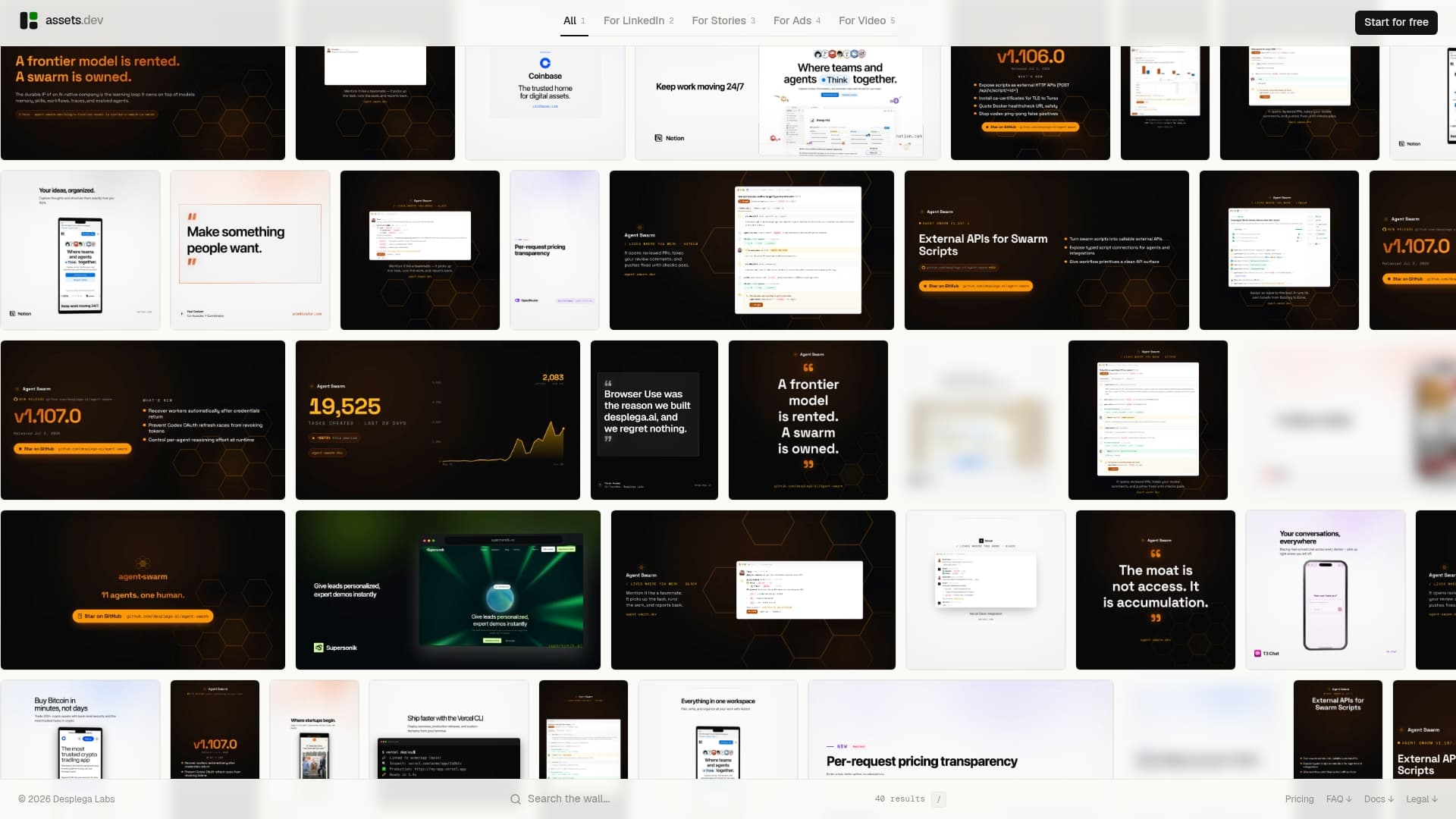
The platform learns your brand in seconds and applies it across every template. You get images, videos, and PDFs formatted for LinkedIn, Instagram, Google, X, and Substack, all from one place. What sets it apart from the tools above is the CLI, API, and MCP integration, which means you can plug asset generation directly into your automated growth workflows without a manual step. The free plan includes 100 monthly credits with no credit card required, and the Pro plan is €9/mo. Through July, new users get 1,000 free credits instead of 100. For teams that need fast, brand-accurate marketing assets without the complexity of an enterprise CMP, Assets is the most direct path to that outcome.
FAQ
What is the best free Bannerflow alternative?
Canva is the strongest free option for teams on a budget, offering a wide template library and a genuinely usable free tier. Assets also offers a free plan with 100 monthly credits and no credit card required.
Which Bannerflow alternative is best for enterprise teams?
Celtra is the most complete enterprise option, with digital asset management, workflow automation, and advanced analytics. Abyssale is a strong second for teams prioritizing high-volume ad production automation.
How long does switching from Bannerflow to an alternative take?
A structured migration with a parallel pilot typically takes four to eight weeks, depending on the number of active campaigns and integrations. Running a pilot on a single campaign before full cutover reduces risk significantly.
Which platforms offer the strongest AI-driven creative automation?
Zuuvi, AdCreative.ai, Quickads, and Extuitive lead on AI capabilities. Zuuvi focuses on dynamic creative optimization tied to campaign data, while AdCreative.ai and Quickads automate the full creative cycle from concept to delivery.
Does Assets integrate with automated marketing workflows?
Yes. Assets supports CLI, API, and MCP integration, which lets teams generate brand-consistent marketing assets directly inside automated growth workflows without manual intervention.
Key Takeaways
The strongest Bannerflow alternatives in 2026 split by use case: enterprise teams need Celtra or Abyssale, performance marketers get the most from Zuuvi or AdCreative.ai, and budget-conscious teams start with Canva or Assets.
| Point | Details |
|---|---|
| Enterprise vs. lightweight | Celtra suits large teams needing DAM and analytics; Canva and Assets suit smaller teams wanting speed. |
| AI intelligence over volume | Platforms like Zuuvi and Extuitive optimize creative performance, not just output quantity. |
| Switching requires a pilot | Running a parallel pilot on one campaign before full migration reduces risk and surfaces integration gaps early. |
| Pricing transparency matters | Most alternatives offer tiered or freemium plans; Bannerflow and Celtra use custom pricing that obscures true cost. |
| Assets for lean automation | Assets delivers brand-consistent images, videos, and PDFs via API and MCP for €9/mo, with a free tier requiring no credit card. |